What Happens If You Pump a Septic Tank Without Locating It First?
If you bought High Desert land with no septic records, you might be tempted to schedule pumping and figure the rest out later. But what happens if you pump a septic tank without locating it properly first? The short answer: you risk crushed lids, broken pipes, a pump truck stuck in soft sand, and a bill that dwarfs the pumping itself. For a property in Hesperia with no paperwork, no visible lid, and a seller who never confirmed anything, it is critical to pump before locating the septic system only after you know exactly where it sits. Locating the tank is not a side task. It is the first step of the job, and skipping it is where most of the damage happens.
This guide walks through what actually goes wrong when pumping starts before locating, why properties with missing records carry the most risk, and how to sequence a locate, an inspection, and a pump-out so you get real answers about the system before you commit more money to the property.
Why Locating Comes Before Pumping, Every Time
A proper septic pumping job starts by finding and uncovering the tank, not by parking a truck and hunting with a shovel. That order exists for a practical reason. The crew needs to know exactly where the tank sits, where the lid is, where the inlet and outlet pipes run, and whether the ground around it can support a heavy vacuum truck.
On a Hesperia property with records, that is straightforward. The county file or an as-built drawing shows the tank offset from the house, and the crew digs a small hole, opens the lid, and pumps. On a property with no records, none of that is known. The tank could be 10 feet from the back door or 40 feet out past a shed. The lid could be under six inches of soil or under a concrete patio someone poured in 1995.
For context, most local regulations require at least 10 feet between a septic system and the building it serves, according to the Minnesota Pollution Control Agency. That gives you a starting zone, but a starting zone is not a location. Guessing inside that zone with heavy equipment is exactly how tanks get damaged.
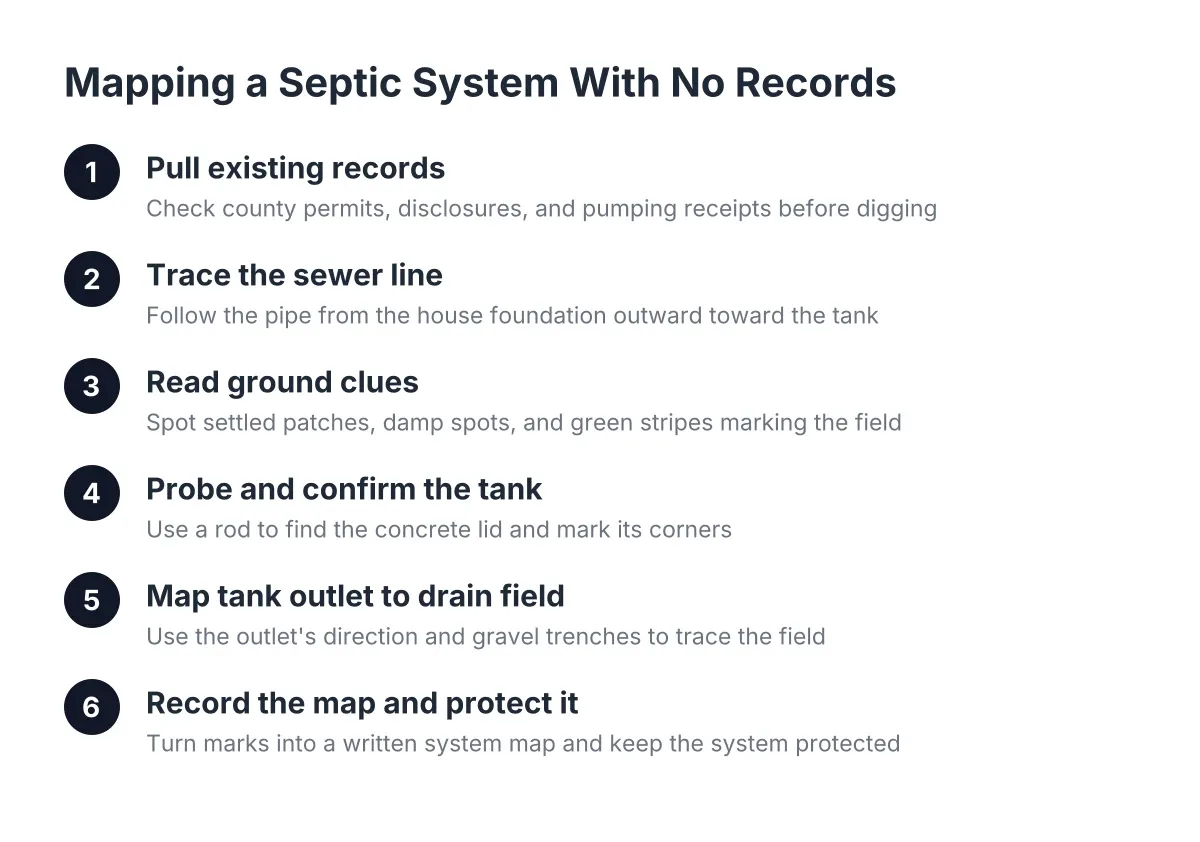
Septic tank locating solves this before any pumping starts. A locate-and-mark visit traces the sewer line out from the house, pinpoints the tank, flags the lid, and gives the pump crew a precise target. For a land buyer with no paperwork, that marked location becomes the first real document the property has ever had for its septic system.
Damage and Risk When You Pump Before Locating Septic Systems
Pumping a septic tank before locating it invites three kinds of damage: physical damage to the tank and its components, property damage from equipment placed in the wrong spot, and hidden system damage that never gets caught because nobody could see inside. Each one costs more to fix than the locate would have cost to prevent.
Crushed lids and broken risers
Older High Desert tanks often have concrete lids that have weakened over decades of soil pressure and moisture cycles. When a crew probes blindly or drives equipment over the unmarked tank area, that lid can crack or collapse. A collapsed lid is not a cosmetic problem. It is an open hole into a tank full of sewage, which is a safety hazard for anyone walking the property, including tenants.
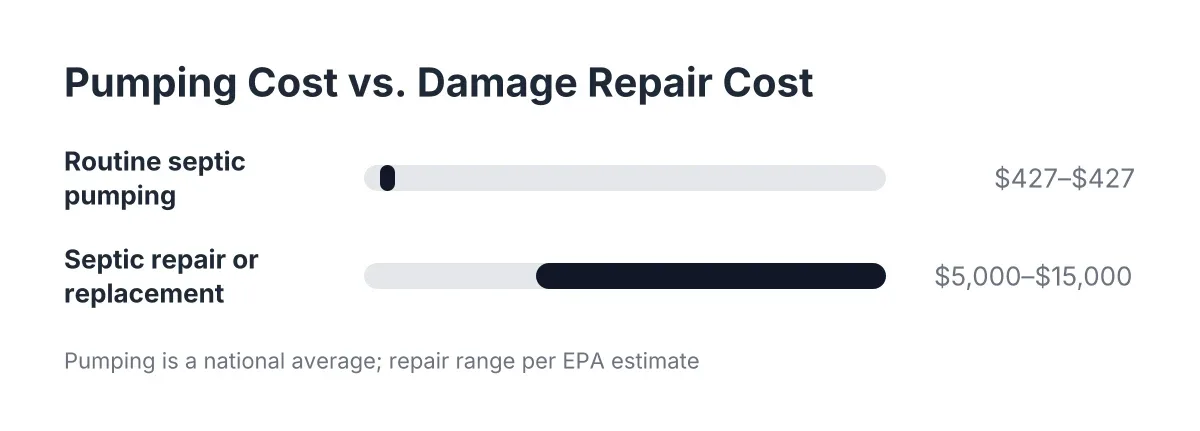
Repairing or replacing damaged tank components gets expensive fast. The EPA estimates septic repair or replacement typically runs $5,000 to $15,000, far more than routine pumping. Compare that to the roughly $427 national average for a septic tank pumping visit, according to Angi data, and the math is clear. The cheapest part of this whole process is doing it in the right order.
Damaged inlet and outlet pipes
The pipes entering and leaving the tank are its most fragile points. The fill around where a pipe penetrates the tank needs thorough compaction when the tank is set, according to Onsite Installer, precisely because that connection point is prone to settling and damage. Decades later, on an old tank with unknown installation quality, those connections may already be marginal.
A shovel or probe rod driven into an unlocated pipe can crack it. The outlet pipe matters most; it sits lower than the inlet because solids float on top of the liquid, and only liquid should exit toward the drain field, as the University of Nebraska-Lincoln Extension explains. Break that outlet, or knock its baffle loose during a blind dig, and solids can wash into the drain field. Once solids clog a drain field, you are into the repair-and-replacement price range, not the pumping price range.
A stuck pump truck and torn-up ground
Vacuum trucks are heavy. Before positioning one, a careful technician walks the ground personally instead of trusting anyone's word that it is solid, especially after rain. High Desert soil can look firm and still give way, and a truck that sinks near an unmarked tank can crush the tank itself on the way down.
Without a marked location, the driver is guessing at both the tank position and the safe approach path. That guess can mean ruts across a rental yard, a broken irrigation line, or a truck parked directly over the tank it came to pump.
The No-Records Problem Makes Every Risk Worse
Every risk above gets multiplied when the property has no septic records. You do not know the tank's location, age, material, size, or last service date. You do not know whether it has one compartment or two, whether the baffles are intact, or whether the previous owner ever pumped it at all.
That last unknown matters more than buyers expect. A tank that has never been pumped since installation can still appear to function. Toilets flush, drains drain, and nothing smells. Meanwhile, solids build toward the outlet and the baffles clog. A tank can look fine from the surface while sitting nearly solid with sludge inside, and only opening the lid and looking reveals it.
Here is a hypothetical that will feel familiar to anyone shopping High Desert rentals. Suppose you are in escrow on a three-bedroom rental in Hesperia built in the 1970s. The seller says the septic "works fine" but has no service records and cannot point to the lid. You could close and hope, or you could order a locate and inspection before your contingency period ends. Say the locate finds the tank under a gravel parking area the previous owner added, and the inspection finds sludge near the outlet baffle. In that scenario, you now have a written report to negotiate with, a marked tank location for every future service visit, and a pumping scheduled before a tenant ever moves in. The alternative was discovering all of it through a sewage backup during a tenancy.
What a Locate-First Visit Actually Looks Like
A locate-and-pump sequence on a no-records property in Hesperia typically follows a clear order. Knowing the steps helps you schedule it efficiently, which matters when you are working against an escrow clock or a vacancy you want to fill.
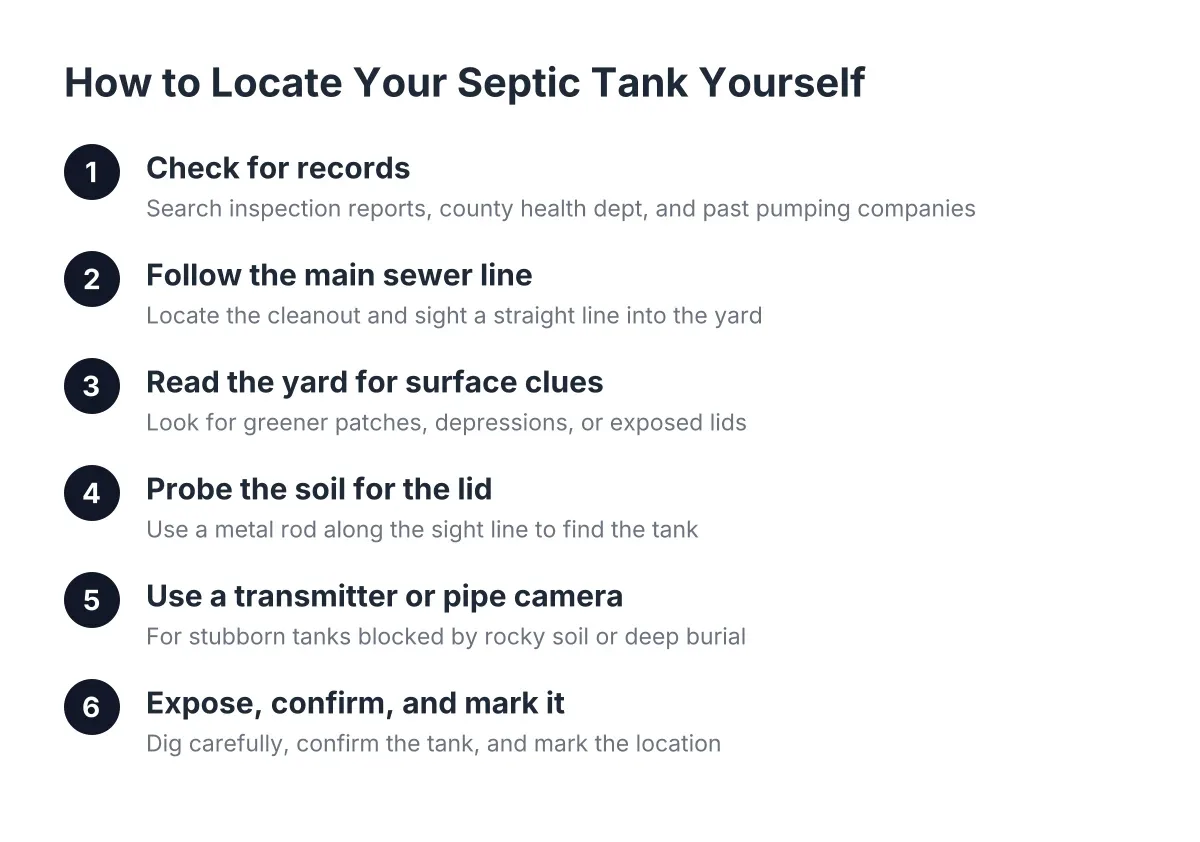
- Trace the sewer line. The crew starts at the house, usually at a cleanout, and follows the main drain line out toward the tank. Locating equipment tracks the line underground so nobody digs on a guess.
- Pinpoint and mark the tank. Once the line reaches the tank, the crew marks the tank footprint and the lid position with flags or paint. You now have a documented location you can photograph and keep in your property file.
- Expose the lid. The crew digs down to the access lid. Depth varies from a few inches to a few feet depending on how the site was graded over the years.
- Inspect before and during pumping. With the lid open, the technician checks liquid level, sludge depth, baffle condition, and signs of leaks or root intrusion. Pumping without this visual check hides the true condition of the system, which defeats the purpose for a buyer who needs answers.
- Pump and document. The tank gets pumped, the contents get hauled by truck to a treatment plant for disposal, according to the New Hampshire Department of Environmental Services, and you get documentation of what was found.
For a small landlord, that documentation earns its keep twice. It supports the purchase decision now, and it becomes the baseline service record for the property going forward. Every future pumping visit is faster and cheaper because the tank is already mapped.
One trade-off worth knowing: exposing the lid yourself before the truck arrives can reduce the bill, since crews commonly charge extra for digging out access. On a no-records property, though, do not dig until the tank has been professionally located. Digging blind is how the damage in this article happens.
What Happens If You Pump an Old Tank the Wrong Way
Even after the tank is found, pumping a neglected tank carries its own risks if it is rushed. This is where a no-records property differs from one with a normal service history, and it is worth understanding what happens if you pump a long-neglected tank carelessly.
First, heavy sludge buildup changes the job. A tank that went a decade or more without service may hold compacted solids that need agitation and extra time to remove. A quick surface pump that leaves the sludge layer behind gives you a receipt but not a serviced tank, and the inspection findings will be incomplete.
Second, old concrete tanks that have sat full for years can be structurally fragile. A careful crew watches the tank walls and baffles as the level drops, because pumping is the only time anyone can see those components. If a baffle is deteriorated or missing, you want that noted in writing before you close on the property, not discovered after solids reach the drain field.
Third, if the system includes a pump or other mechanical components, those need their own care. A septic pump should never be tested dry; the tank must hold water before any pump test runs, or the test itself can wreck the pump. Systems with pumps, float switches, or other mechanical parts should also be inspected once a year, according to the EPA, which is a real ownership cost to factor into your numbers on the property.
Protecting Your Investment After the Locate
Once the tank is located, marked, inspected, and pumped, a few habits keep the system from becoming a surprise expense again. For a landlord running one to five septic-served rentals around Hesperia, these are the items worth building into your process:
- Record the location permanently. Photograph the marked tank and lid with reference points, measure offsets from the house corners, and keep it with the property file. Consider adding a riser so the lid is reachable without digging next time.
- Set a pumping schedule based on occupancy. Penn State Extension notes that an active family of four generally needs pumping every two to three years. A rental with full-time tenants behaves like an owner-occupied home, not a vacation cabin.
- Watch water waste between visits. A single leaky or running toilet can push as much as 200 gallons of extra water per day into a septic system, according to the EPA. In a rental, that toilet runs until a tenant reports it, so check fixtures at every turnover.
- Account for garbage disposals. Homes with disposals generate significantly more sludge; the Massachusetts Department of Environmental Protection recommends annual pumping for those households. If your rental has a disposal, budget accordingly or remove it.
- Mark the tank before any site work. Knowing the exact tank location before a project like a swimming pool, an addition, or new paving prevents thousands of dollars in damage. Give the marked location to every contractor who brings equipment onto the lot.
In addition, keep the tank location in mind for anything involving a well. A septic tank sited close to a well can contaminate drinking water if it leaks, which is one more reason the locate report matters on rural High Desert parcels.
When to Bring In a Professional Instead of Guessing
Some situations on a no-records property go beyond what any owner should handle alone. If the tank turns out to sit under a structure or paving, if the inspection finds a failing tank or saturated drain field, or if you are planning new construction that needs a percolation test and a designed system, you need licensed help. Installing or replacing a system requires certification beyond a pumping operation, including knowledge of soil types, percolation rates, and local regulations, as the New Hampshire Department of Environmental Services notes. A percolation test must be performed before installing a system to confirm the soil drains properly, per the University of Nebraska-Lincoln Extension, and that is county-regulated work.
Also worth confirming early: whether the property is on septic at all. Homes inside city sewer districts connect directly to municipal treatment, according to the Environmental Finance Center Network, while unsewered High Desert parcels rely on septic. Parts of Hesperia have both situations, so verify before you pay for a locate.
The bottom line for a buyer holding a property with no septic paperwork is simple. What happens if you pump without locating first is damage, guesswork, and missing information at exactly the moment you need certainty. What happens when you locate first is the opposite: a marked tank, a documented condition, a clean pump-out, and a property file that finally tells the truth about what is buried in the yard. As of 2026, with repair costs running several times the price of routine service, doing this in the right order is the cheapest decision you will make on the property.
If you need your septic tank serviced, Hesperia Septic can help.
Prefer to talk it through? Call (760) 249-7872 — a quick call is usually the fastest way to get a straight answer for your situation.