7 Signs You Can’t Find Your Septic Tank and Need Professional Locating
You need the tank pumped, inspected, or marked for a permit, and nobody can tell you where it is. No map, no lids, no obvious spot in the yard. That is the exact problem septic tank locating solves, and it comes up constantly in Hesperia and the rest of the High Desert, where older properties often changed hands three or four times with no septic records passed along.
Here is the honest part. Some tanks can be found in twenty minutes with a probe and a shovel. Others hide under decades of fill dirt, a patio, or a gravel driveway, and no amount of guessing will find them. This guide walks you through the signs that you have crossed from "look around a bit" into "call a locating crew," step by step.
Why Finding the Tank Matters Before Anything Else Happens
A septic truck cannot pump what it cannot reach. Before any pumping, inspection, sale, or remodel, someone has to physically find the tank and expose a lid. According to the US EPA, a typical residential septic system has two main parts: the tank itself and a drain field that disperses the liquid. Both are buried, and on an older High Desert property, both can be invisible from the surface.
This matters more than most owners realize. The EPA estimates septic repair or replacement typically runs $5,000 to $15,000, far more than routine pumping. Driving a skid steer or pouring a footing over an unknown tank is one of the fastest ways to turn a maintenance job into a replacement job. Locating first is cheap insurance.
The steps below follow the order a careful property owner should work through. Each one ends with a clear signal: either you found it, or you have hit one of the signs that professional septic tank locating is the right next move.
Step 1: Check for Records Before You Touch a Shovel
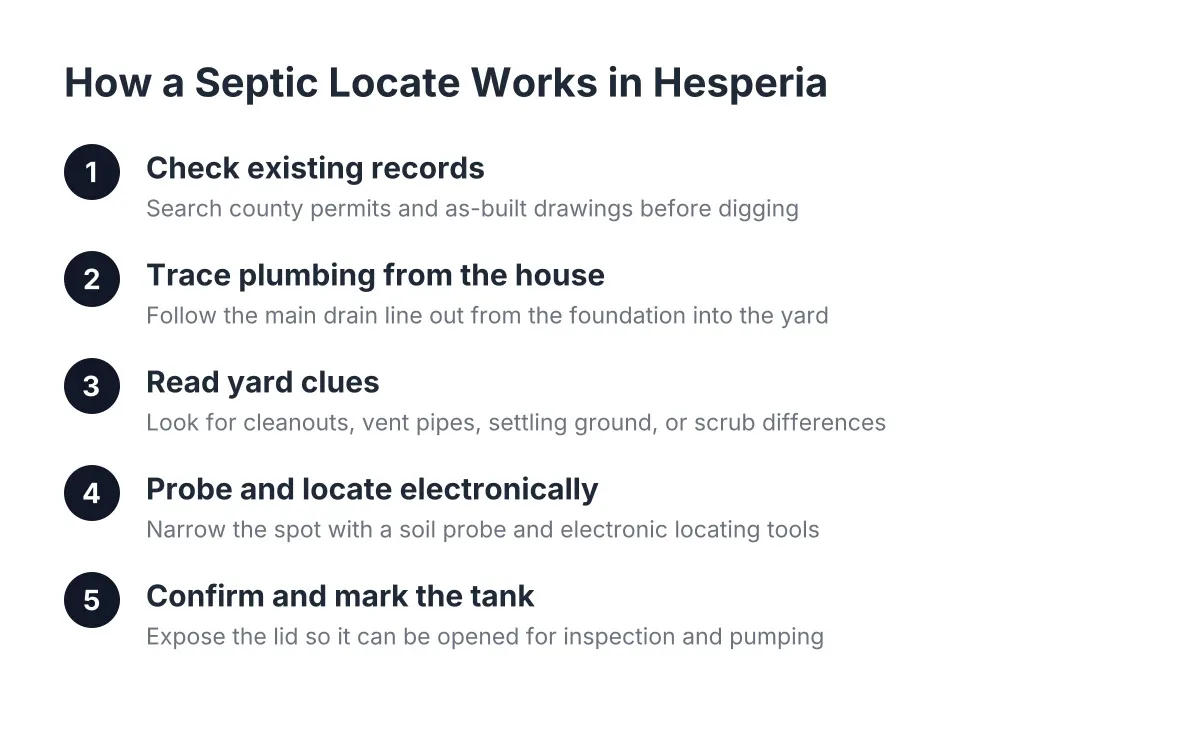
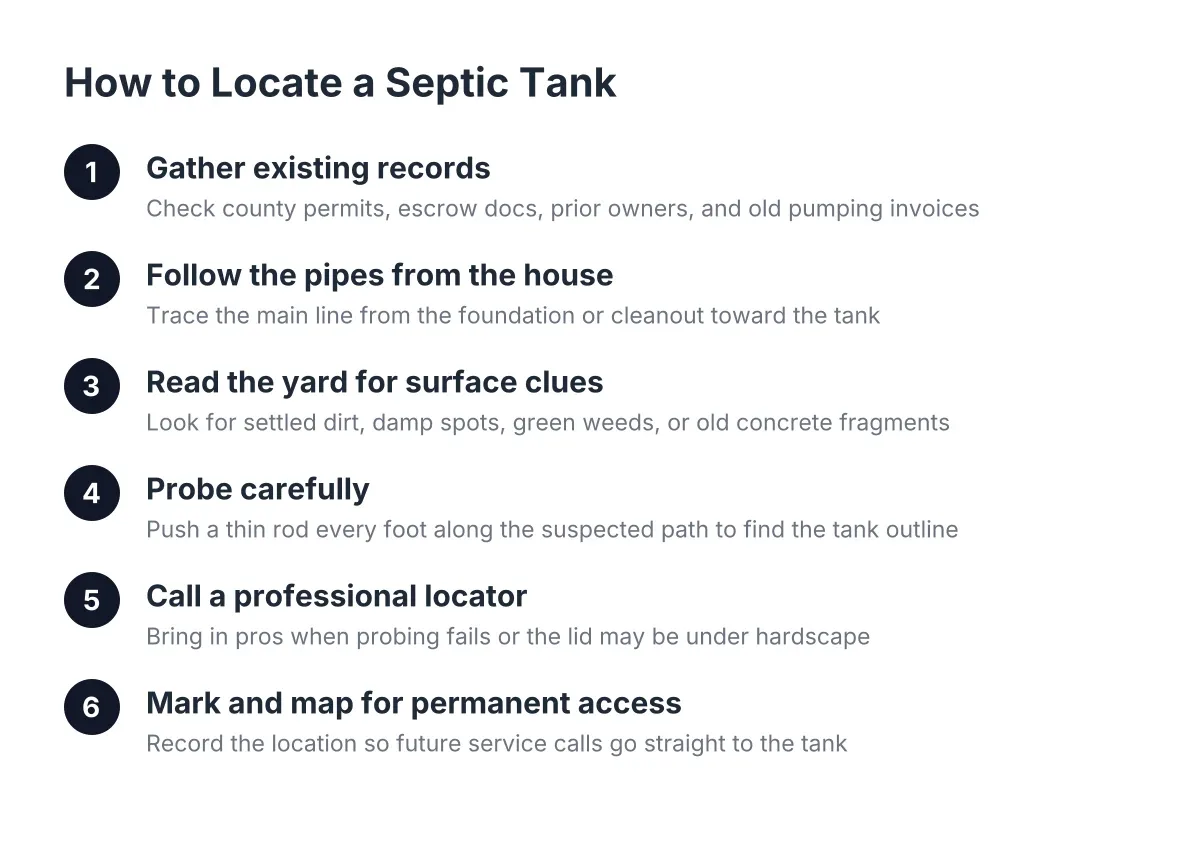
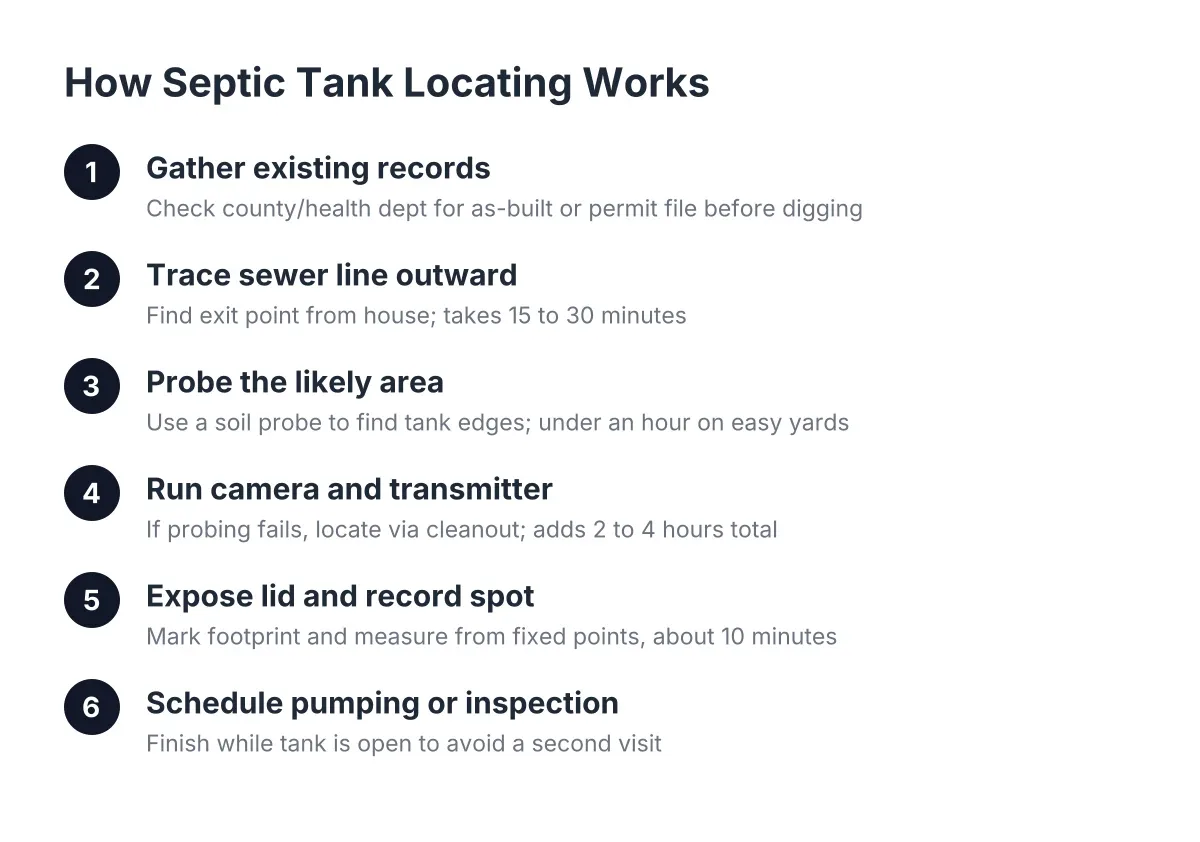
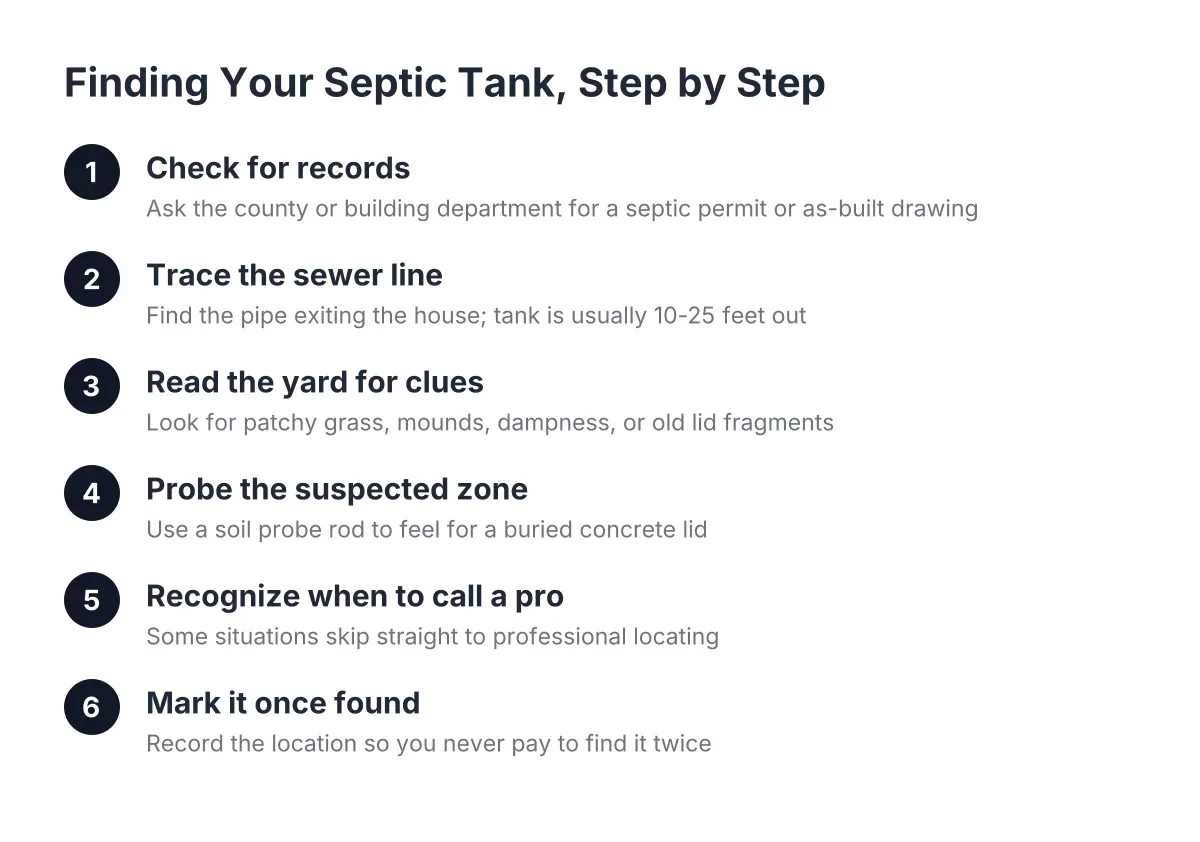
First, call your county environmental health or building department and ask for the septic permit or "as-built" drawing for your address. In San Bernardino County, many permitted systems have a sketch on file showing the tank's distance from the foundation. If that drawing exists, you can measure it out in minutes.
Also check the paperwork from your home purchase. Inspection reports sometimes note the tank location even when the county file is empty.
The sign you need help: the county has nothing on file. This is common for older Hesperia properties, especially homes built before modern permitting or systems installed informally decades ago. No records means every method after this point is detective work, and it is the first signal that a locating service may save you a weekend of digging.
Step 2: Trace the Sewer Line Out of the House
Next, find where the main sewer line leaves the building. In a crawlspace or at the foundation, look for a 3 to 4 inch pipe heading out through the wall or slab. The tank almost always sits on a fairly straight line from that exit point, usually within 10 to 25 feet of the house on a standard lot. Most local regulations require at least 10 feet between the septic system and the building it serves, according to the Minnesota Pollution Control Agency, so do not waste time probing right against the foundation.
Look for a cleanout too, the capped pipe sticking up near the house. A cleanout tells you the pipe's direction and gives a pro a direct access point later.
The sign you need help: the sewer line exits under a slab with no visible cleanout, or the pipe direction is a complete mystery. Without a starting line, surface probing turns into guesswork across the whole yard.
Step 3: Read the Yard for Surface Clues
In addition to the pipe, the ground itself often talks. Walk the likely area and look for:
- A rectangular patch where grass or weeds grow differently than the surrounding dirt
- A slight mound or a shallow depression from old excavation settling
- A spot that stays damp or greener than the rest of a dry High Desert yard
- Old lid fragments, risers, or inspection pipes barely poking through the soil
- Areas snow or frost melts faster in winter mornings
However, be realistic about desert lots. Hesperia yards are often bare dirt, decomposed granite, or gravel, and the lush-green-patch trick that works in wetter climates tells you nothing here.
The sign you need help: the yard reads completely uniform, or the likely zone sits under landscaping rock, a shed, or concrete. Surface clues only work when the surface is still original.
Step 4: Probe Carefully and Use the Right Technique for Locating a Septic Tank
If steps 1 through 3 gave you a target zone, a soil probe rod is the classic tool for tank discovery. Push a thin metal rod into the ground every foot or so along the suspected pipe path. Soil gives; a buried concrete lid stops the rod with a distinct solid feel, and you can trace the tank's edges and corners from there. Technicians find tanks this way all the time, often with nothing more than a probe and a shovel.
Two cautions. Probe gently, because older tanks can have deteriorated lids, and a rod punched through a weak lid is dangerous. Also remember tank shapes vary by region; the International Code Council notes some areas use rectangular concrete tanks while others use circular ones, so do not assume the outline you expect.
The sign you need help: you have probed the full likely zone and hit nothing, or the tank sits deeper than a hand probe can reach. Tanks buried under feet of fill dirt, which happens when lots get regraded, are out of reach for DIY probing.
Step 5: Recognize the Situations That Skip Straight to a Pro
Some scenarios are not worth a single hour of DIY effort. Call a septic tank locating service first if any of these describe your property:
- You are buying land or a home with no septic records and need the tank found and marked before closing. Buyers who skip this step sometimes discover the tank later by accident, with an excavator.
- The suspected tank area sits under a driveway, patio, deck, or addition built after the system went in.
- You are pulling a remodel or grading permit in 2026 and the county wants the system located and marked on your site plan.
- Sewage is already backing up into the house or yard. In a septic backup, every hour spent hunting for a lid is an hour the mess gets worse; crews that handle emergency septic pumping locate and pump in one visit.
- The property changed hands multiple times and even longtime neighbors cannot point to the tank.
For example, suppose a buyer picks up a 1970s Hesperia property on a half acre, planning a shop building. No county drawing exists, the yard is graded gravel, and probing finds nothing. In that scenario, a locating crew would run a camera with a transmitter through the cleanout, trace the pipe electronically, and mark the tank and lids in an hour or two, instead of the buyer trenching blind and risking the drain field.
Step 6: Understand What Professional Septic Tank Locating Actually Does
A professional crew does not dig up your yard hoping to get lucky. The standard approach runs a sewer camera with a built-in transmitter through the cleanout or a pulled toilet. The camera travels the pipe, a receiver above ground follows the signal, and the tank gets pinpointed without trenching. Flushable transmitters work the same way where a camera will not fit. From there, targeted probing finds the exact lid positions, and the crew exposes and marks them.
Expect a real fee for this. Camera locating is specialized work with specialized equipment, and it costs more than a basic pump-out visit. For perspective, Angi data puts the average cost of septic tank pumping itself at $427, with a typical range of $250 to $1,250 depending on tank size and access. Locating is a separate line item, and prices vary by property, so get the scope clear before the truck rolls.
One honest trade-off: if your system turns out to be unpermitted, failing, or oddly built, locating may be the first step toward a bigger conversation with the county or a repair contractor. A locator finds the tank; an inspection tells you its condition, and the EPA recommends a professional inspection at least every three years regardless.
Step 7: Mark It So You Never Pay to Find It Twice
Finally, once the tank is found, lock in that knowledge. Measure from two fixed points on the house to each lid and write it down. Sketch the tank, lids, and pipe path on a simple site map and keep it with your house records. Consider adding risers that bring the lids to grade, so future pumping takes minutes instead of digging.
In addition, if a pump-out is coming, expose the lid before the technician arrives when you safely can. A tank that is already open gets serviced faster, and on an emergency call that difference matters.
More than one in five U.S. households rely on septic or small cluster systems, according to the EPA, yet a surprising share of those owners could not point to their tank on a map. Spend one afternoon, or one locating visit, fixing that, and every future service call on your Hesperia property gets cheaper, faster, and far less stressful.
If you need your septic tank serviced, Hesperia Septic can help.
Prefer to talk it through? Call (760) 249-7872 — a quick call is usually the fastest way to get a straight answer for your situation.