Why Septic Tank Locating Is Critical Before Pumping, Cleaning, or Repairs
If your toilets are backing up or there's a wet spot spreading in the yard, you want a pump truck out fast. Here's the catch: no one can pump, clean, or repair a tank they can't find. That's why the ability to locate septic tank records and understand where your tank sits is critical before any service happens, especially in Hesperia and the High Desert, where older properties often have missing or incomplete septic records. This guide walks you through the steps to locate and mark your tank before the truck arrives, so the crew can get straight to work.
Why does this matter so much here? Many High Desert homes were built decades ago, permits got lost, and lids sit buried under a foot or more of sand and decomposed granite. A landlord buying a rental in Hesperia may get keys and a deed, but no site drawing showing where the tank sits. If that's you, follow these steps in order.
Step 1: Why Locating Septic Tank Records and the Tank Itself Comes Before Everything Else
Treat locating your septic tank as critical prep work, not an optional extra. The first move on any proper pumping job is finding and uncovering the tank, because digging blind or guessing at lid placement risks cracked lids, broken inlet pipes, and torn-up landscaping.
There's also a cost angle. According to Angi data, septic tank pumping averages $427, ranging from $250 to $1,250 or more depending on tank size and location. If the crew has to spend an hour hunting for a buried lid and digging it out, you can expect that bill to climb. Locating and exposing the lid ahead of time keeps the visit short and the invoice predictable.
The stakes get bigger with repairs. The EPA estimates septic tank repair or replacement typically costs between $5,000 and $15,000, far more than routine pumping. You do not want anyone excavating near a tank, or driving heavy equipment over one, without knowing exactly where it sits.
Step 2: Gather Whatever Records Exist
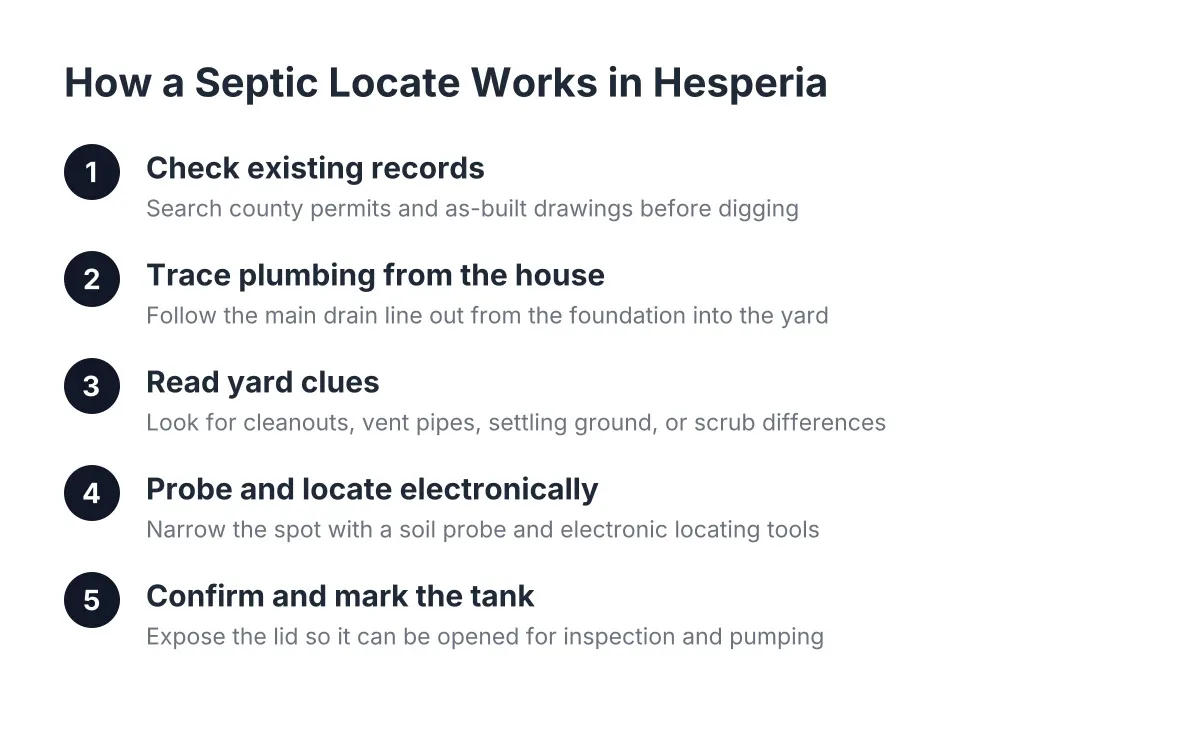
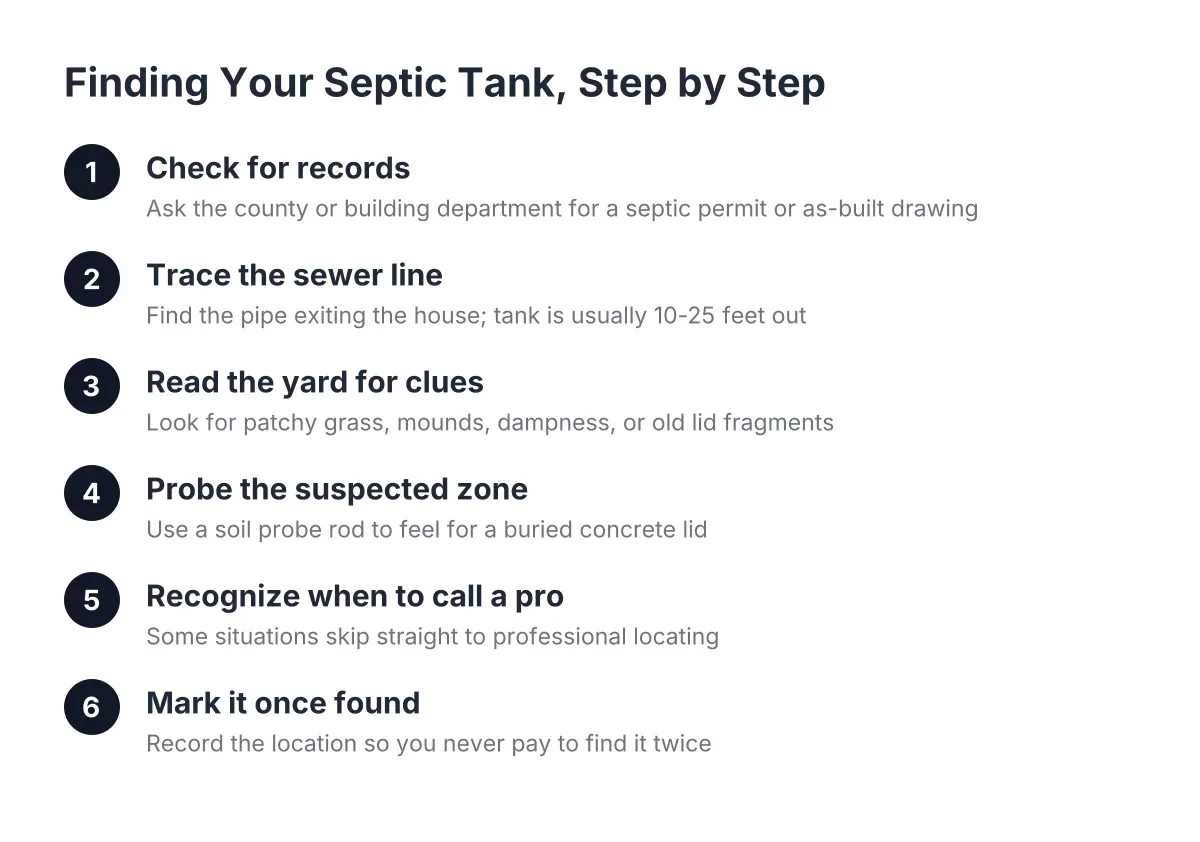
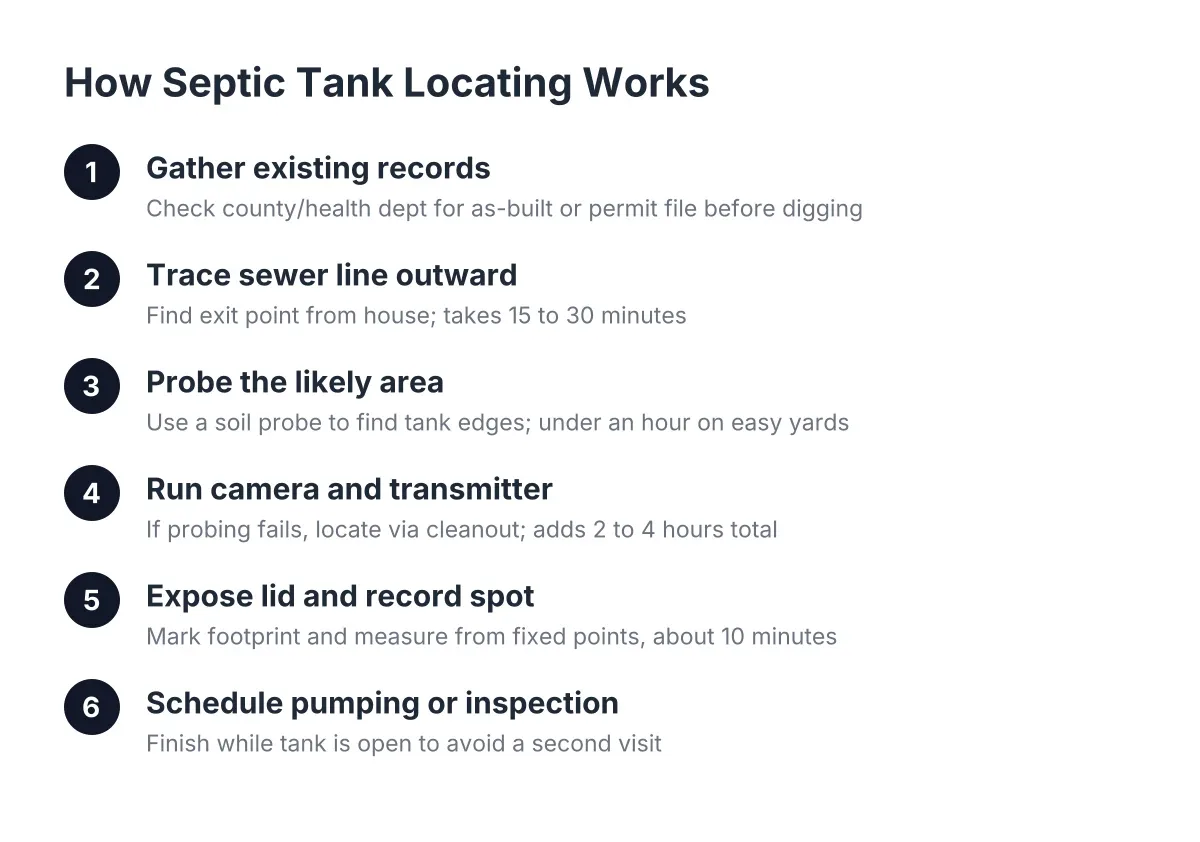
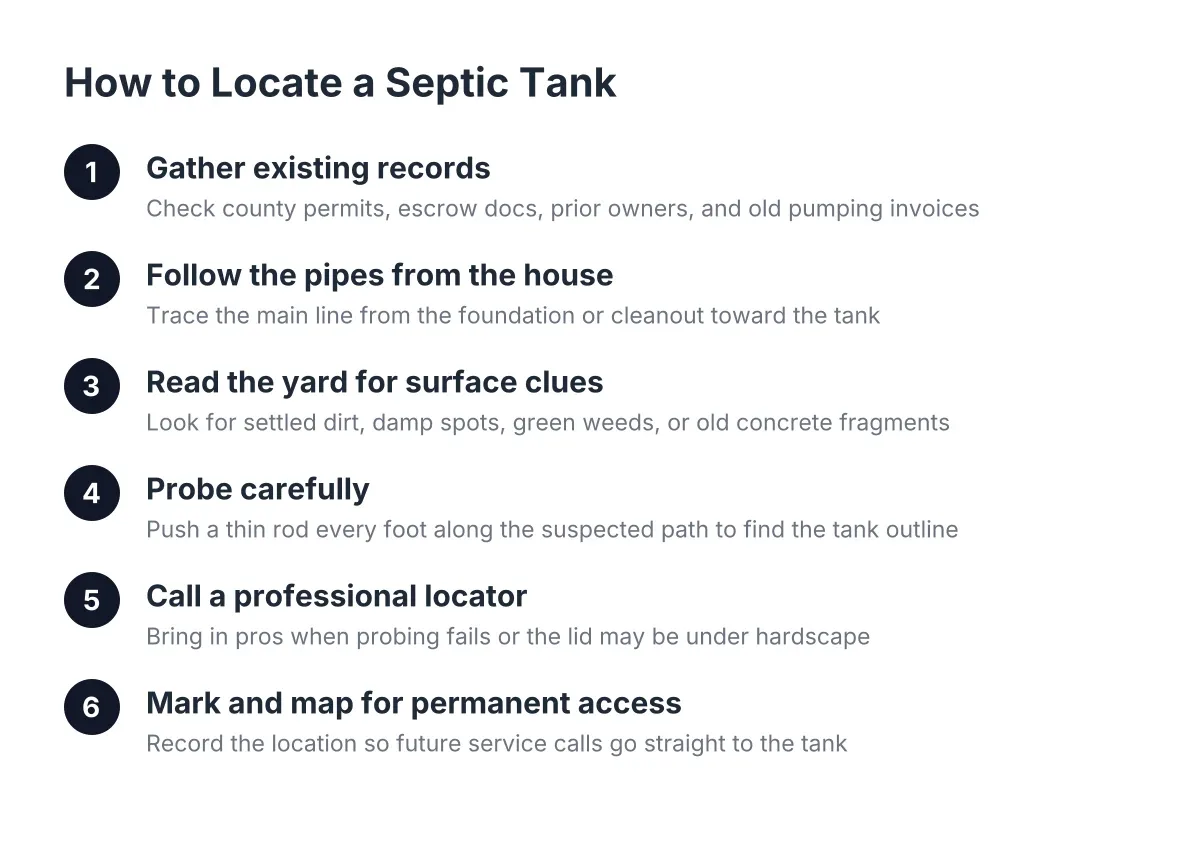
Start with paper before you start with a shovel. Even incomplete records can narrow the search from the whole yard to a 10-foot zone.
Check these sources first:
- San Bernardino County permit records. The county environmental health department may have an as-built drawing or permit on file showing the tank and drain field layout.
- Home inspection or escrow documents. If the property sold recently, the septic certification from that sale often includes a sketch.
- Previous owners or long-time neighbors. In older Hesperia neighborhoods, the neighbor who's been there 30 years sometimes knows exactly where every tank on the street sits.
- Prior pumping invoices. If you're a landlord who inherited a tenant file, look for old septic receipts; some note lid location or access details.
However, don't be surprised if you come up empty. Missing records are the norm for older High Desert properties, not the exception. If you find nothing, move to the next step.
Step 3: Follow the Pipes From the House
Next, trace the plumbing. The main sewer line leaves the house in a straight run toward the tank, and that line is your best map.
Go into the crawl space or basement, if the house has one, and note where the main drain exits the foundation wall. Outside, look for a cleanout pipe, the capped white or black pipe sticking a few inches out of the ground near the house. A cleanout tells a technician which direction the line runs and makes tracing the pipe to the tank much faster.
From that exit point, walk a straight line away from the house. Most local regulations require at least 10 feet between a septic system and the building it serves, according to the Minnesota Pollution Control Agency, so the tank is rarely right against the foundation. In practice, many tanks sit between 10 and 25 feet out, in line with the main drain.
Step 4: Read the Yard for Surface Clues
In addition to the pipe path, the ground itself leaves hints. High Desert yards hide lids well under blow sand, but a careful walk often turns up something.
Look for:
- A rectangular patch where the dirt has settled or sunk slightly
- A spot where snow melts first in winter, or where the ground stays damp when everything else is bone dry
- Greener or faster-growing weeds in one defined area
- Old concrete fragments, riser rings, or rebar stubs at grade
- A low mound or berm that doesn't match the rest of the grading
If you're dealing with an active backup, a sewage smell or soggy area near the suspected tank zone is an obvious marker. Do not stand or park on it. A saturated area over a tank or drain field may not support weight, and that goes double for vehicles.
Step 5: Probe Carefully, or Know When to Stop
Once you've narrowed the zone, you can probe. Use a thin metal rod or soil probe and push it into the ground gently every foot or so along the suspected pipe path. A solid thunk at a consistent depth usually means concrete; the tank's outline will show up as a rectangle of those hits.
Probe at an angle and go easy. Older tanks can have deteriorated lids, and jamming a rod through a weak spot is both a repair bill and a safety hazard. Never lean over an open or partially open tank, and never let kids or pets near the work area. The gases inside a septic tank can be deadly, and falls into tanks happen.
This is also the honest limit of DIY. If probing turns up nothing, if the tank seems deeper than two feet, or if you suspect the lid sits under a patio, driveway, or addition, stop and call a professional locating service. Guessing wrong under hardscape gets expensive fast.
Step 6: Bring In Professional Help to Locate Septic Tank Records and the Tank
A professional septic tank locating service finds and marks a buried tank using tools and experience a homeowner doesn't have, and it matters most on properties with no records at all. For land buyers, remodels, and pre-sale inspections in the High Desert, this step turns a guess into a marked, documented location.
A locating crew typically flushes a small transmitter down a toilet or feeds it through the cleanout, then follows its signal above ground to the tank. Because the crew pumps and services tanks for a living, they also read the property the way Step 3 and Step 4 describe, just faster. On a sandy Hesperia lot with a 1970s house and zero paperwork, that combination usually beats a weekend of probing.
Here's an illustrative scenario. Say a small landlord buys a two-unit rental near Main Street in Hesperia. The seller has no septic paperwork, the tenant reports slow drains, and a pumping appointment is useless until someone finds the tank. A typical crew would trace the line from the cleanout, locate the tank about 15 feet off the back wall, dig the lid clear, and mark it, so every future pumping visit starts at the lid instead of at square one.
Step 7: Mark, Map, and Make Access Permanent
Finding the tank once isn't enough; you want to never search for it again. After locating, do three things before you backfill or move on.
- Measure and sketch. Record the distance from two fixed points, such as corners of the house, to the lid. Keep the sketch with your property records; landlords should keep a copy in each property file.
- Mark the spot. A flat paver, a decorative rock, or a short stake over the lid works. For tanks buried more than a few inches, ask about installing a riser, which brings the access point to grade.
- Protect the area. Keep vehicles, sheds, and new concrete off the tank and drain field. Knowing the exact location before projects like a pool or garage addition prevents thousands of dollars in damage.
As a result, every future service call gets cheaper and faster. The EPA recommends the average household have its septic system inspected at least once every three years, and each of those visits starts with tank access. Locate once, document it well, and that cost never repeats.
When Septic Tank Locating Becomes Critical Right Now
Septic tank locating becomes critical, immediately, when sewage is backing up into a tub or pooling in the yard and no one knows where the tank is. In an emergency, skip the slow steps: pull any records you can grab in five minutes, find the cleanout, and tell the septic company up front that the tank location is unknown. A crew that handles both locating and emergency septic pumping can find the tank and pump it in one visit instead of two.
One caution for backup situations: a full tank isn't always the whole story. A clogged inlet baffle is a common cause of septic backups, according to the Washington State Department of Health, and the crew can only check that baffle after the tank is located and opened. Finding the tank is step one of the diagnosis, not just step one of the pumping.
Whether you're a homeowner staring at a backed-up tub at 8 p.m. or a landlord closing on a Hesperia rental with no paperwork, the order of operations in 2026 is the same as it's always been. Find the tank first. Everything else, pumping, cleaning, inspection, and repair, depends on it.
If you need your septic tank serviced, Hesperia Septic can help.
Prefer to talk it through? Call (760) 249-7872 — a quick call is usually the fastest way to get a straight answer for your situation.