Do I Need Septic Tank Locating Before Selling Property in Hesperia, CA?
If you are selling property in Hesperia, or buying a parcel with no septic records, you have probably asked yourself some version of this question: do I need septic tank locating before selling? For most High Desert properties, the honest answer is yes. A buyer, a lender, or the county will want to know where the tank sits and what shape it is in. If nobody can point to the lid, the sale can stall right there.
This guide walks through why locating matters in a sale, when you can skip it, what the process looks like on a Hesperia lot, and how to handle it without blowing up your escrow timeline. It is written for the situation that comes up constantly out here: a property changes hands, the previous owner left no paperwork, and nobody has any idea where the tank is buried.
Why Hesperia Property Sales Run Into Missing Septic Records
Hesperia and the surrounding High Desert sit outside centralized sewer service for many parcels. Homes in cities are typically connected directly to municipal sewage treatment, according to the Environmental Finance Center Network, but rural and semi-rural properties like many in Hesperia rely on their own septic systems. That is less common statewide; according to the U.S. Environmental Protection Agency, only about 10 percent of California homes are on septic, compared with highs of 55 percent in states like Vermont. Nationally, more than one in five U.S. households depend on individual septic systems or small cluster systems, according to the same agency.
The practical result is that septic knowledge in California is thin. Buyers from Los Angeles or Orange County often have never owned a septic property. Sellers inherited the house, or bought it decades ago, and the as-built drawing is long gone. Lids get buried under years of blown sand, gravel, landscaping, and sheds. On an older Hesperia property, it is normal for nobody alive to know where the tank is.
That matters at sale time for a simple reason. Septic problems get discovered during real estate transactions more than at any other moment. A home inspection flags slow drains, the buyer's agent asks for a septic inspection, and suddenly everyone needs to open a tank that nobody can find.
When and Why Septic Locating Before Selling Matters
Do I need septic tank locating before selling a Hesperia property? In most cases, yes, because a septic inspection cannot happen until someone physically finds and opens the tank, and buyers and lenders increasingly require that inspection before closing. If you already know the exact lid location and have records, you can skip the locating step and go straight to inspection and pumping.
Here is the chain of events that makes locating unavoidable for most sellers with no records:
- The buyer or lender asks for a septic inspection as a condition of the sale.
- The inspector needs the tank opened to evaluate it; an inspection through a toilet flush alone tells nobody much.
- The tank usually needs pumping so the inspector can see the baffles, walls, and liquid levels.
- None of that can happen until the tank and its access lid are physically located and exposed.
So locating is not an optional add-on. It is step one. If you list the property without knowing where the tank is, you are betting that the buyer will not ask. In 2026, with lenders and agents more cautious about septic-served properties, that is a bad bet.
There is a second reason sellers should want this done early. If the system has a problem, you want to know before a buyer's inspector finds it ten days before closing. The EPA estimates septic repair or replacement typically costs between $5,000 and $15,000, far more than routine pumping. Finding that out mid-escrow puts you in the weakest possible negotiating position. Finding it out before listing lets you fix it, price it in, or disclose it on your terms.
What a Septic Locate and Mark Involves on a High Desert Lot
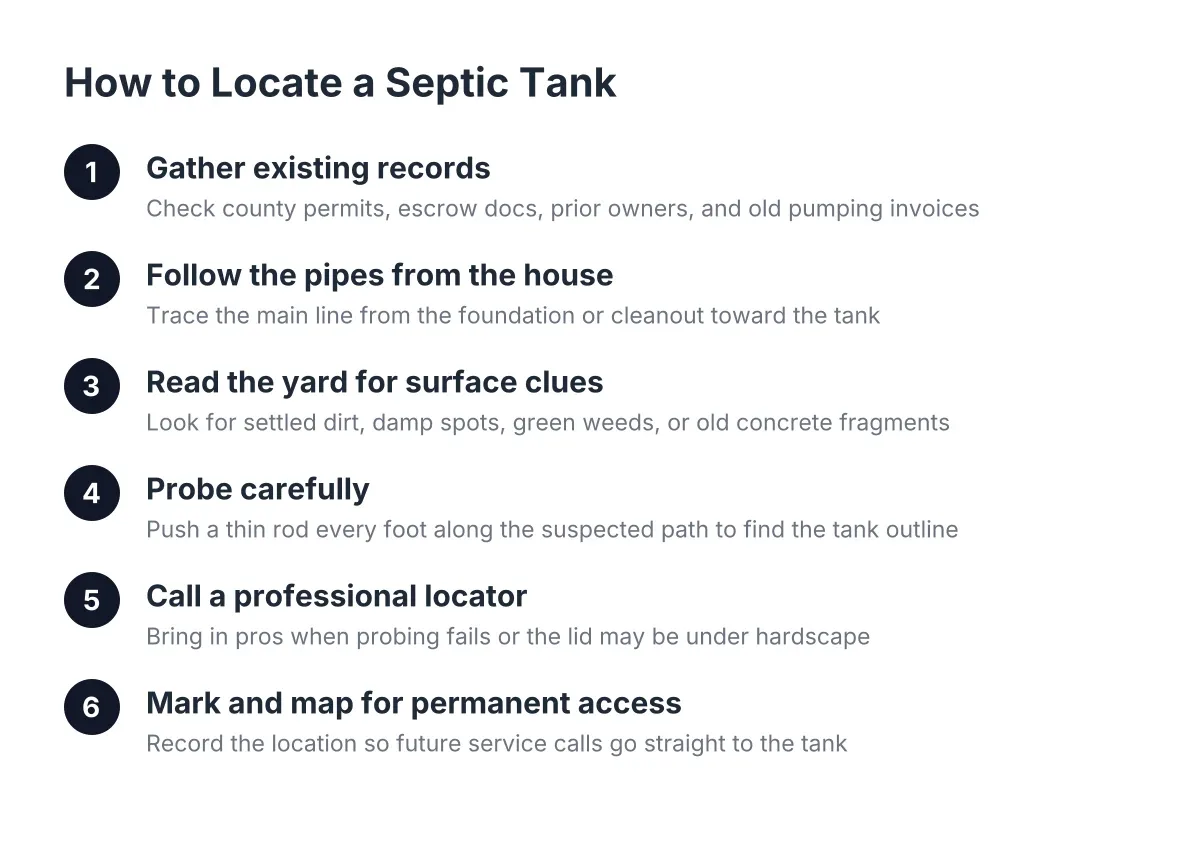
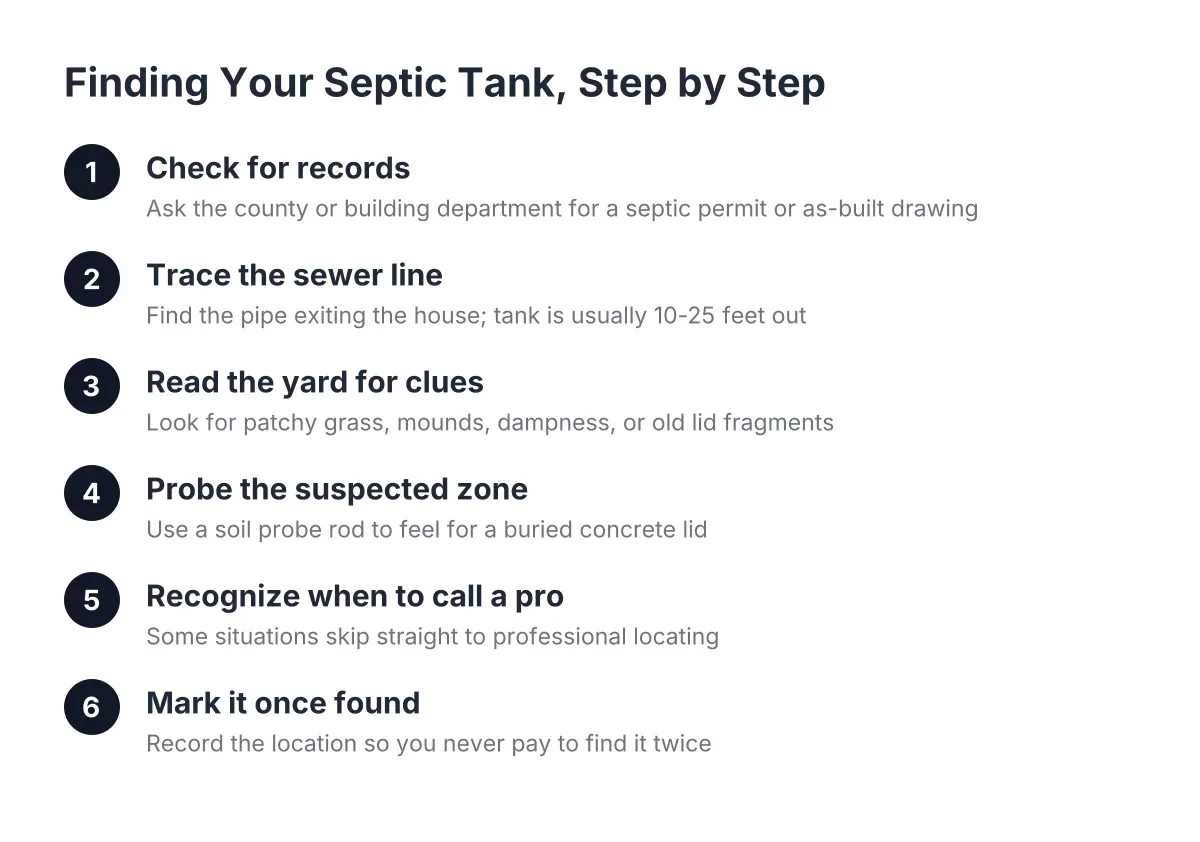
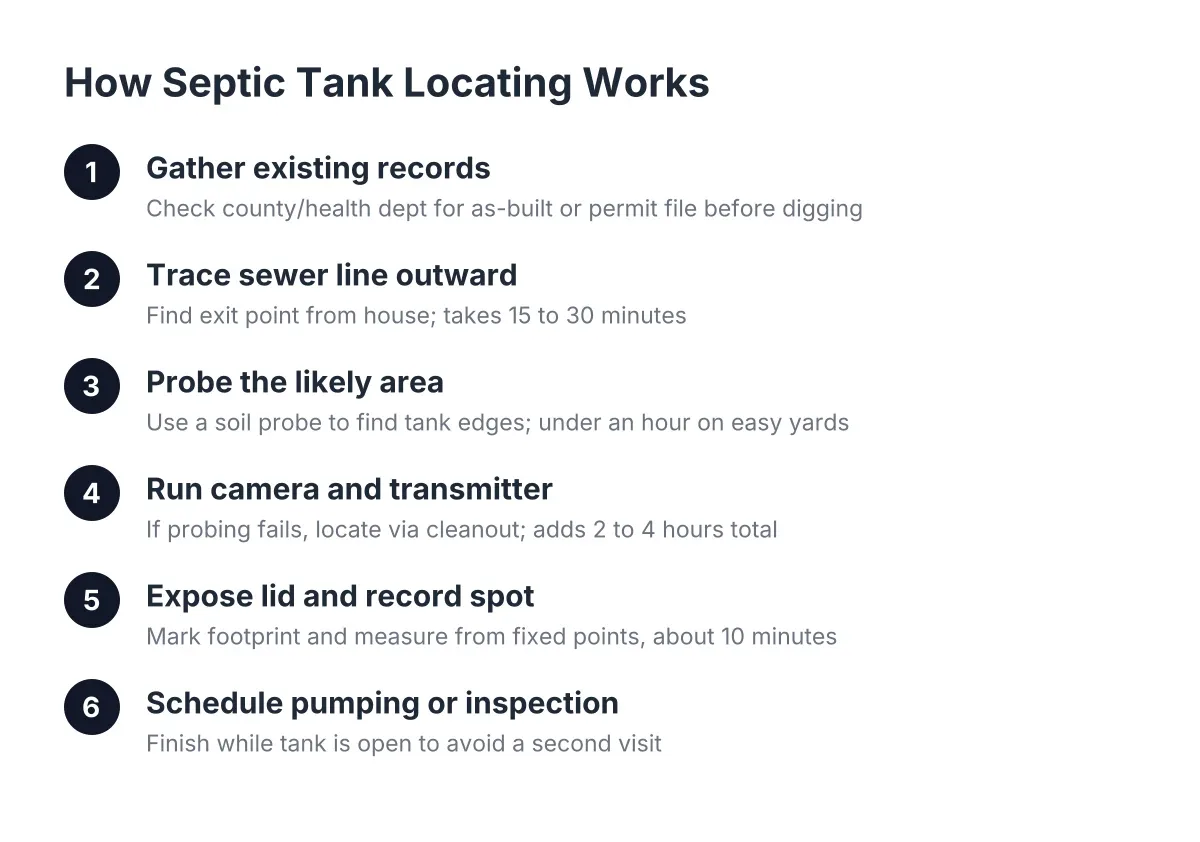
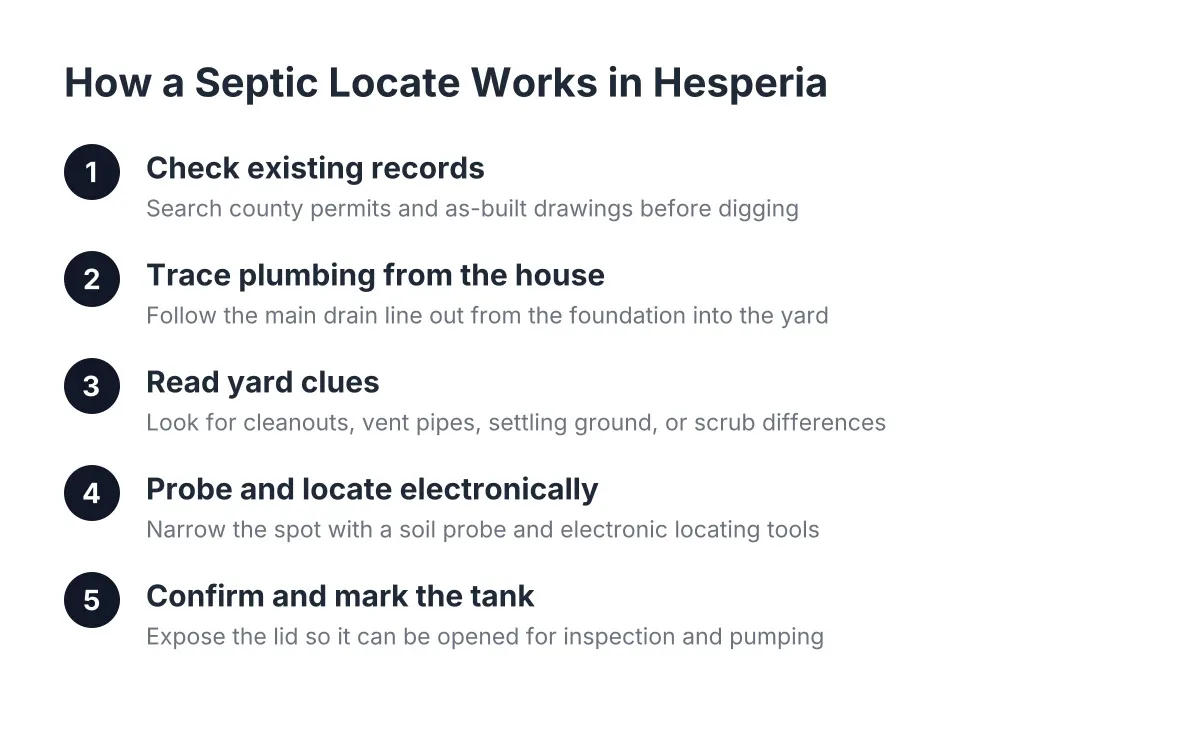
A septic locate on a Hesperia property starts with detective work, not a shovel. A crew performing septic locating before selling works through a sequence, and understanding it helps you prepare the property and set expectations with your agent and buyer.
Start with records, even partial ones
First, check what paperwork exists before anyone digs. San Bernardino County may have permit records or as-built drawings for the original installation, especially on homes built in recent decades. An as-built can show the tank's distance from the house and its orientation, which turns a yard-wide search into a few square feet. Older High Desert homes often predate good recordkeeping, but a records check costs little and sometimes solves the whole problem.
Trace the plumbing from the house
Next, the physical search starts at the house. The main drain line leaves the home through the foundation, and the tank sits along that line somewhere out in the yard. Most local regulations require at least 10 feet between a septic system and the building it serves, according to the Minnesota Pollution Control Agency, so the search extends well away from the foundation, not right against it. On High Desert lots with big setbacks, tanks can sit farther out than new owners expect.
Crews read the yard for clues: cleanouts, vent pipe positions, a patch of ground that settles differently, a strip where snow or frost melts first on cold mornings, or a rectangle where the native scrub grows differently than the surrounding sand.
Probe, locate electronically, and confirm
From there, the crew narrows the spot with a soil probe, feeling for the tank's lid or walls under the surface. On stubborn properties, a plumbing camera with a locating transmitter can be pushed through the drain line; a receiver above ground then traces the pipe's path and pinpoints where it enters the tank. That electronic trace is the reliable fallback when the yard gives up no clues, though it adds cost compared with a quick probe-and-dig.
Once found, the lid gets exposed and the location marked, with measurements recorded from fixed points like the house corners. Those measurements become the record the next owner never had. Ask for them in writing; a simple sketch with two measurements is worth more than any memory.
When Do I Need a Septic Inspection Along With the Locate?
You need a septic inspection along with the locate whenever a sale, refinance, permit, or remodel is in play, and locating alone only tells you where the tank is, not whether it works. For a Hesperia property sale, plan on locating, pumping, and inspection as one coordinated job, because the inspector needs an open, pumped tank to evaluate the system honestly.
An inspection after pumping lets a trained eye check the things that decide whether a buyer is getting a working system or a $5,000 to $15,000 problem:
- Liquid levels before pumping, which hint at whether the drain field is accepting water
- The condition of the inlet and outlet baffles
- Cracks, root intrusion, or deterioration in the tank walls
- Evidence of past backups or overflow
- Whether the outlet sits properly below the inlet, since solids float on top and only liquid should exit toward the drain field, as the University of Nebraska-Lincoln Extension explains
A typical residential system has two main parts, per the US EPA: a tank that clarifies wastewater, and a drain field that disperses the clarified liquid into the soil. A written report covering both components is the document a buyer, lender, or county reviewer actually wants. The EPA also recommends professional inspection at least every three years for the average household, so a pre-sale inspection is not an exotic request; it is the system's normal checkup, timed to the transaction.
One honest limitation: no inspection can see everything. A drain field evaluation from the surface involves judgment, and a system can pass inspection and still develop problems later. For questions about system capacity, permits for an addition, or a suspected failing drain field, bring in a professional and, where required, the county health department rather than relying on a visual check alone.
Timing the Locate So It Does Not Delay Escrow
The fear that keeps sellers from scheduling this work is escrow delay. In practice, the locate itself is usually the fast part; the delay comes from scheduling it late and discovering a problem with no time left to respond.
Suppose a hypothetical seller in Hesperia lists a 1970s home on a half-acre lot with no septic paperwork. The buyer's offer includes a septic inspection contingency with a 17-day window. If the seller waits until the contingency clock starts, they have to find a crew, locate a tank nobody has seen in 50 years, dig to the lid, pump, inspect, and get a written report, all inside that window, with any repair negotiation still to come. If the same seller handles the locate and inspection two weeks before listing, the contingency period becomes paperwork instead of a scramble.
Therefore, the practical order for a seller with no records looks like this:
- Check county records for an as-built or permit history before paying for any field work.
- Schedule the locate and pump-out before listing, or at the latest, immediately after accepting an offer.
- Have the lid exposed before the crew arrives if you already know roughly where it is; an exposed lid saves locating time and keeps the visit focused on pumping and inspection.
- Get the tank location documented in writing, with measurements, and hand that document to the buyer at closing.
- If the inspection finds problems, get a repair scope and estimate right away so you can negotiate from facts instead of fear.
On cost, treat any figure as an estimate until a crew sees your property. For reference, Angi data puts average septic tank pumping at $427, with a range of $250 to $1,250 or more depending on tank size and location. A locate adds to that when electronic tracing or extended digging is needed, but it is still small money next to a collapsed sale or a mid-escrow price cut.
What If the Locate Turns Up a Bad System?
A bad inspection result feels like the worst case, but discovering it yourself is the best version of a bad situation. You control the information, the timeline, and the response. The alternatives are worse: the buyer's inspector finds it and the deal craters, or nobody finds it and the new owner faces a sewage backup in their first year, with your name on the disclosure forms.
If the system needs major work, you generally have three paths. You can repair before listing, which costs money now but keeps the sale clean. You can disclose and adjust the price, letting the buyer handle it with full knowledge. Or, for a failing system that cannot be repaired in place, you can get county guidance on replacement, which involves permits, a percolation test to confirm how the soil drains, and health department inspection as part of the installation process, as the University of Nebraska-Lincoln Extension and the Caroline County Health Department both describe. In Hesperia's sandy, fast-draining soils, perc results are often workable, but only a test on your specific parcel answers that.
One thing not to do: do not plan on moving the tank to suit a remodel or a buyer's site plan. Relocating a tank generally means redesigning the whole system, and county approval is never guaranteed. If a buyer intends to build an addition, knowing the tank and drain field layout before they draw plans is exactly why the locate-and-mark documentation matters.
Buying a Hesperia Property With No Septic Records? Same Answer
Everything above applies in reverse if you are the buyer. If a seller cannot show you where the tank is, do not accept "it's out there somewhere" as a disclosure. Make the locate and inspection a condition of your offer. The question is not whether you can afford the service; it is whether you can afford a surprise. Failing to inspect before buying is how new owners end up needing a new tank or a major repair right after the system starts backing up.
Buyers should also settle the basics early. Do I have septic or sewer at this address? In parts of Hesperia the answer varies street by street, and your agent or the water district can confirm. If the answer is septic, do I need a septic inspection before closing? Yes, and it should include a physical locate, a pump-out, and a written report, not a glance at the yard.
For a buyer, that written report and the marked tank location are the two documents that end the no-records problem permanently. You close knowing exactly where the system sits, what condition it is in, and when it was last pumped. The next time the question comes up, whether for routine pumping, a remodel, or your own eventual sale, the answer is in a folder instead of buried under three feet of High Desert sand.
If you need your septic tank serviced, Hesperia Septic can help.
Prefer to talk it through? Call (760) 249-7872 — a quick call is usually the fastest way to get a straight answer for your situation.