Grease Trap Cleaning vs. Pumping: Which Service Your Kitchen Actually Needs
If you run a commercial kitchen or own a rental property with a restaurant tenant, you have probably searched for grease trap cleaning, pumping, or both, and found companies using the two words like they mean the same thing. They do not. Knowing the difference between grease trap cleaning and pumping matters when an inspector is due next month, or when a floor drain is already backing up and you need the right truck today. This guide breaks down what each service actually involves, when to choose one over the other, and what to ask before you book a crew in Hesperia or anywhere in the High Desert.
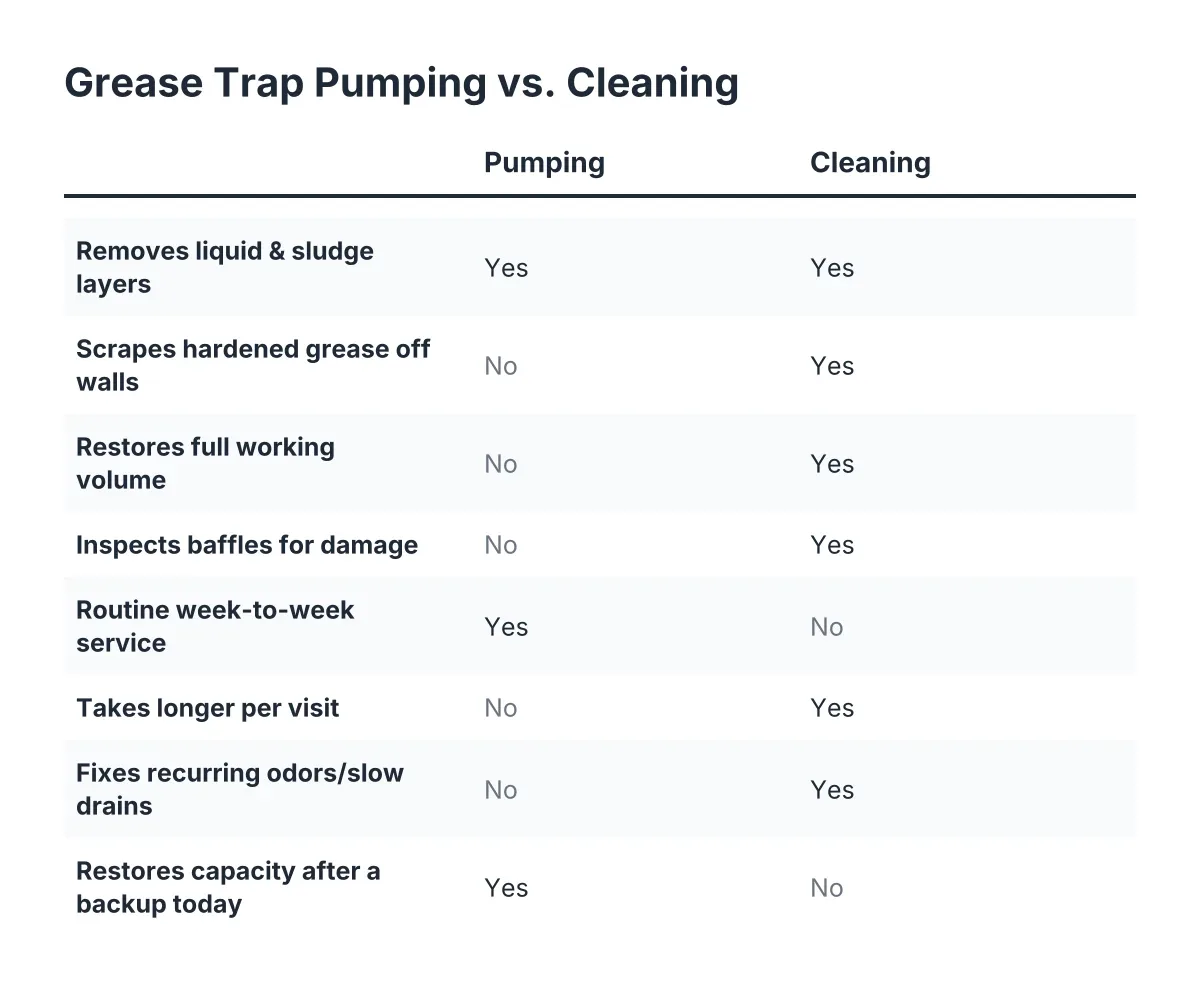
The short version: pumping removes the contents of the trap, cleaning removes the contents plus the buildup stuck to the trap itself. Most kitchens need both on a schedule, and the wrong choice at the wrong time is how a passing kitchen ends up with a failed health inspection or sewage in the dish pit.
What Grease Trap Pumping Actually Involves
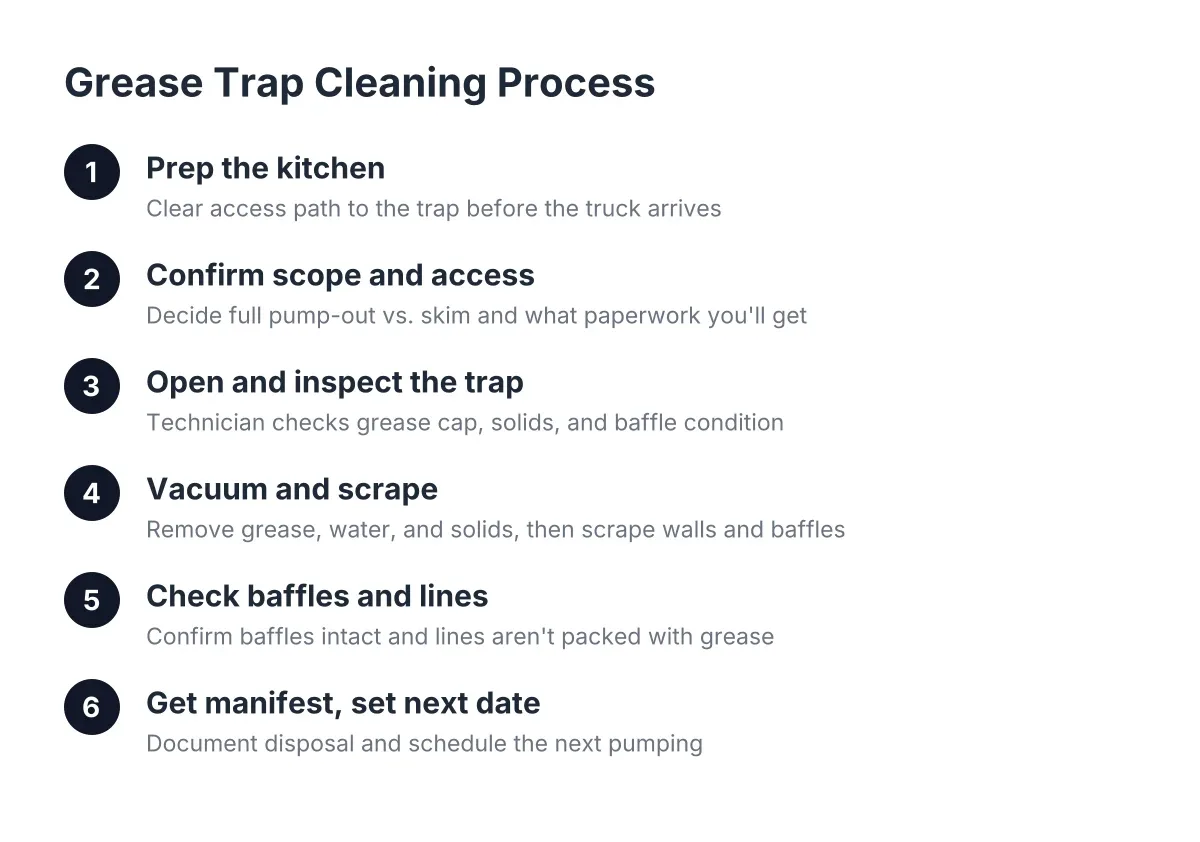
Grease trap pumping is the removal of everything inside the trap with a vacuum truck. A technician opens the lid, drops a hose into the trap, and pulls out the floating grease layer, the wastewater in the middle, and the settled food solids at the bottom. The waste goes into the truck's tank and gets hauled to an approved disposal facility. It does not get dumped on site or handled by your staff.
That layering matters. A grease trap works the same way a septic tank does. Fats, oils, and grease float to the top and form a scum layer, heavier solids sink to the bottom as sludge, and the liquid in between flows out to the sewer or septic system. According to the U.S. Environmental Protection Agency, this three-layer separation is exactly how these tanks are designed to work. Pumping only counts as done right when all three layers come out, not just the liquid. A crew that skims the easy liquid and leaves the sludge has not solved your problem; they have delayed it.
For most kitchens, pumping is the routine service. It restores the trap's full capacity so it can keep catching grease before that grease reaches the sewer line or your septic system. The stakes are real. According to the U.S. Environmental Protection Agency, grease is the most common cause of reported sewer blockages, responsible for 47 percent of cases. And the volume adds up fast; Wastewater Digest reports that a single restaurant can release between 800 and 17,000 pounds of grease into the sewer system each year.
What Grease Trap Cleaning Adds on Top of Pumping
Grease trap cleaning starts where pumping ends. After the trap is pumped empty, cleaning means scraping the hardened grease off the walls, baffles, and lid, breaking up any crusted buildup in the corners, and often rinsing the trap so the technician can see the baffles and inspect their condition. Some crews call this a full clean-out or a scrape-down. Whatever the name, the point is the same: the trap goes back into service with its full working volume and its baffles clear.
Why does that matter? Because a trap that gets pumped but never cleaned slowly shrinks. Hardened grease coats the interior and reduces how much the trap can hold. The baffles, which force water to slow down so grease can separate, get caked over and stop doing their job. You can pump that trap on a perfect schedule and still fail an inspection, because the inspector lifts the lid and sees an inch of rock-hard grease lining the walls.
Cleaning also gives the technician a look at the trap's condition. With the walls scraped and the baffles visible, they can spot a cracked baffle, a corroded wall, or a damaged outlet before it turns into a backup. That inspection value is a big part of why cleaning belongs in your rotation even if pumping is your regular service.
One honest trade-off: a full grease trap cleaning takes longer than a straight pump-out, and it costs more per visit. For a small indoor trap the difference may be under an hour; for a large in-ground interceptor it can add real time to the job. If your budget only covers one deep clean a year, most operators pair it with a regularly scheduled pump-out so the truck is already on site.
Grease Trap Cleaning and Pumping: How to Choose Between Them
The right choice depends on what problem you are solving. Here is the plain-language breakdown.
Choose pumping when:
- The trap is full or near full but draining normally
- You are on a routine maintenance schedule and the last full clean was recent
- You need waste hauled and documented before an inspection and the trap interior is in decent shape
- A backup just happened and you need capacity restored today
Choose cleaning (pump plus scrape-down) when:
- The trap has been pumped repeatedly but odors or slow drains keep coming back
- Hardened grease is visible on the walls or baffles when the lid comes off
- You are taking over a property or a new tenant is moving in and you do not know the service history
- An inspector flagged the trap's condition, not just its fill level
- The trap has gone a year or more without a full clean-out
For most working kitchens, the practical answer is a rotation: routine grease trap pumping on a set interval, with a full cleaning folded in once or twice a year. The pumping keeps capacity available week to week. The cleaning resets the trap and keeps the interior in a condition an inspector will accept.
There is one situation where neither service is the whole answer. If the trap backs up again within days of a proper pump and clean, the problem is likely downstream, in the line between the trap and the sewer or septic tank. That calls for a diagnosis, not another pump-out, and it is worth having a professional trace the line before you spend more on service visits that cannot fix it.
Why This Matters for Health Inspections in 2026
Health and wastewater inspectors do not just check whether your trap is empty. In most jurisdictions, including the High Desert, they want to see three things: the trap is being serviced at an adequate frequency, the waste is being hauled by a legitimate service and disposed of properly, and the trap itself is in working condition. Cleaning and pumping each cover a different part of that checklist.
Documentation carries most of the weight. Every service visit should produce a record showing the date, the volume removed, and where the waste went. Keep those records on site and organized. When an inspector asks for your grease trap service history, a folder of dated manifests answers the question in thirty seconds. A shrug does not. As of 2026, many local sewer authorities also set minimum pumping intervals for food service businesses, so confirm what your jurisdiction requires rather than guessing.
This is where choosing a real grease trap cleaning and pumping service, rather than the cheapest truck on a classifieds site, pays for itself. A crew that hands you proper paperwork after every visit is protecting your inspection record, not just emptying a tank. If a hauler cannot tell you where the waste goes, that is a disqualifier, because improper disposal can land on the business that generated the waste.
How Do You Know When a Grease Trap Needs Service?
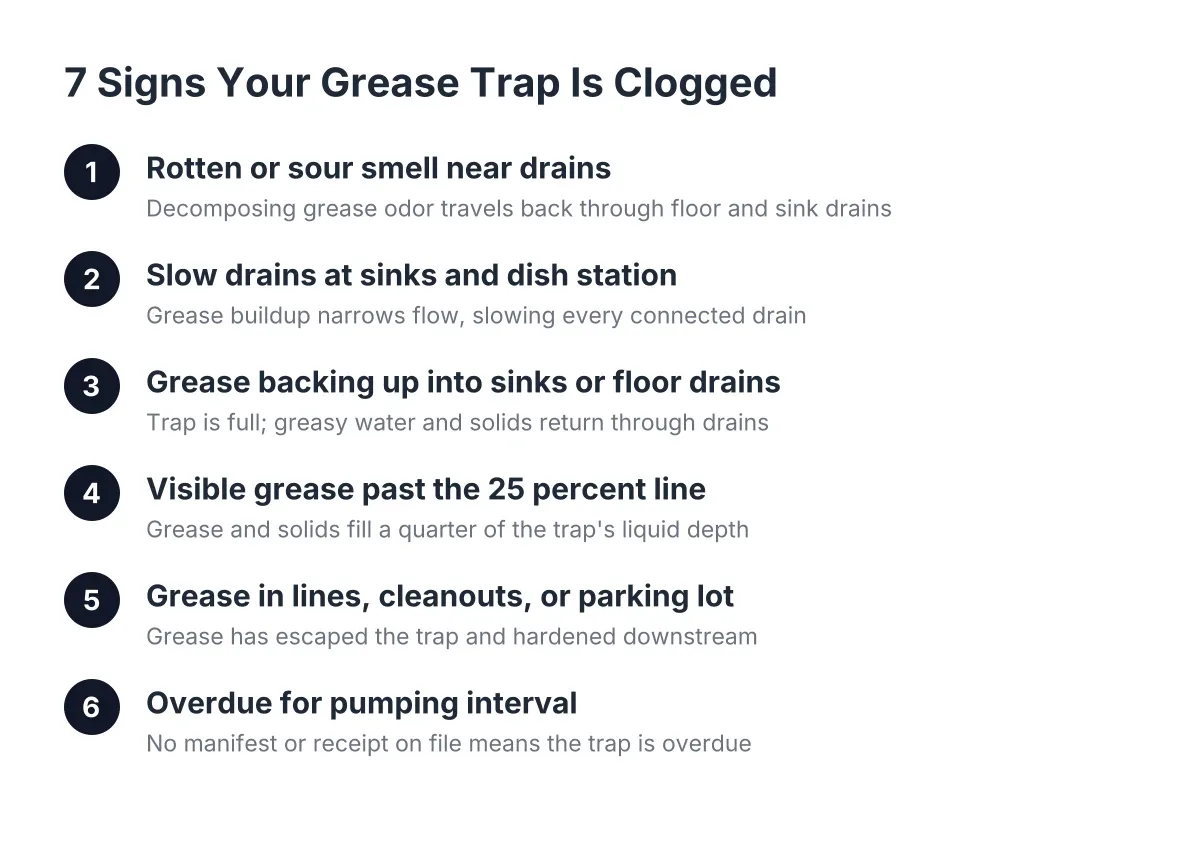
A grease trap needs service when the combined grease and solids take up a large share of its capacity, or when you notice odors, slow drains, or grease escaping past the trap. Many operators use the general rule that a trap should be serviced before it is a quarter full of grease and solids, though local rules may set a stricter standard.
In practice, the warning signs show up in the kitchen first. Drains near the trap slow down. A sour, rancid smell builds up near floor sinks even after mopping. Grease appears in downstream cleanouts where it should never be. Any of those signs means the trap is past due, and if they show up soon after a pump-out, the trap likely needs a full cleaning or has a downstream problem.
How Long Does It Take to Clean a Grease Trap?
Cleaning a grease trap typically takes anywhere from about thirty minutes for a small under-sink unit to a few hours for a large in-ground grease interceptor. The time depends on the trap's size, how hardened the buildup is, how accessible the lids are, and whether the crew is doing a straight pump-out or a full scrape-down.
For a working restaurant, the scheduling detail matters more than the clock time. A good crew can service most traps outside peak hours so the kitchen never stops. If your trap is indoors, plan the visit for before open or after close, since the lid has to come off inside the building and the process is not subtle.
Grease Trap vs. Grease Interceptor: A Quick Distinction
You will see both terms in quotes and regulations, and the difference affects which service you book. A grease trap usually means the smaller indoor unit, often under or near the sink, holding a modest volume. A grease interceptor is the large in-ground tank outside the building, often holding hundreds or thousands of gallons, and it looks and behaves much more like a septic tank.
The service logic is the same for both, but the scale changes everything. Small indoor traps fill fast and need frequent attention; some kitchens handle interim maintenance in-house and bring in a pump truck for full removals. In-ground interceptors need a vacuum truck every time, and pumping one is closer to septic tank pumping than to scooping out a sink trap. A company that already runs vacuum trucks for septic work in Hesperia is set up for exactly this kind of job, since the equipment and the disposal process are the same trade.
One more note for property owners: a residential grease trap is rare, but some older homes and small multi-unit properties in the High Desert have them, usually tied to a septic system. If you own a rental with one, it needs periodic service just like a commercial trap, because grease that gets past it ends up as scum in your septic tank and, eventually, in your drain field.
What Grease Trap Cleaning and Pumping Costs Depend On
Grease trap service pricing varies with the size of the trap, how full and how hardened the contents are, access, and whether the visit is scheduled or an emergency. As illustrative estimates only, a small indoor trap might run in the low hundreds per visit, while a large in-ground interceptor can run several hundred to over a thousand dollars, depending on volume and disposal fees.
A few factors consistently move the number:
- Trap size and volume removed. Disposal is charged on volume, so a 1,500 gallon interceptor costs more to service than a 50 gallon indoor trap.
- Condition. A trap that has gone years without a full cleaning takes longer and may need extra work to break up hardened grease.
- Access. Buried lids, traps under equipment, or long hose runs add time.
- Timing. An emergency same-day pump-out generally costs more than a routine scheduled visit; that pattern holds across the industry.
- Documentation and disposal. Legitimate haulers pay to dispose of waste at approved facilities, and that cost is part of the price. Suspiciously cheap service often means corners cut on exactly this step.
Compare that to the cost of skipping service. A grease-driven backup can close a kitchen for a day or more, and if you are a landlord, it can mean an unrentable unit and an angry tenant. On septic-served properties the downside is steeper. The EPA estimates septic repair or replacement typically costs between $5,000 and $15,000, and grease pushed past a neglected trap into a septic system is one way to get there.
A Realistic Scenario: The Landlord With a Restaurant Tenant
Suppose you own a small commercial building in Hesperia with a taco shop as your tenant, and the lease makes you responsible for the grease interceptor. The tenant calls on a Thursday: the floor drain by the three-compartment sink is backing up, and the county inspector is due within the month.
In that scenario, the first visit is a pump-out, because the immediate job is restoring capacity and stopping the backup. When the crew opens the interceptor, they find the baffles caked with hardened grease, a sign the trap has been pumped over the years but never actually cleaned. The right call is to authorize the full cleaning while the truck is already on site, since the incremental cost is far lower than a second visit, and the scraped-down trap will pass a visual inspection that a merely emptied one might not.
After the visit, you keep the service record with the date and gallons removed. When the inspector arrives, the trap is clean, the paperwork is in hand, and the question is settled in minutes. From there, you put the trap on a standing schedule so the next call from the tenant is not another Thursday emergency.
Questions to Ask Before You Book a Service
Whether you are comparing grease trap cleaners near me results or calling a septic company that also runs grease routes, a few direct questions separate a real operation from a truck with a magnet sign:
- Do you pump all three layers, including the settled solids, or just the liquid?
- Does the price include a scrape-down of the walls and baffles, or is that separate?
- Will I get documentation showing the date, volume, and disposal location?
- Where does the waste actually go?
- Can you service the trap outside my kitchen's operating hours?
- If the trap backs up again right away, will you help diagnose the line downstream?
A company that answers these plainly is a company you can put on a schedule. Vague answers on disposal or documentation are the red flag that matters most, because that paperwork is what stands between you and a failed inspection.
The bottom line: pumping empties the trap, cleaning restores it. Most kitchens in Hesperia and the surrounding High Desert need both, on a rotation matched to how much grease the kitchen produces. Get the trap on a schedule, keep every service record, and the grease trap becomes one of the few pieces of your building that never surprises you.
If you need your septic tank serviced, Hesperia Septic can help.
Prefer to talk it through? Call (760) 249-7872 — a quick call is usually the fastest way to get a straight answer for your situation.