What Happens During Professional Grease Trap Cleaning: Step-by-Step Process and Timeline
If you run a restaurant or commercial kitchen, knowing exactly what happens during the grease trap cleaning process helps you plan around it, keep your paperwork straight, and pass your next health inspection without a scramble. This guide walks through the service step by step, from the pre-visit prep to the manifest you file away for the inspector. It is written for owners and managers who cannot afford a failed inspection or a Friday-night backup, and it applies whether your trap sits under a three-compartment sink or you have a larger in-ground interceptor outside the building.
The stakes are real. According to the U.S. Environmental Protection Agency, grease is the most common cause of reported sewer blockages, responsible for 47% of cases. And according to Wastewater Digest, a single restaurant can release between 800 and 17,000 pounds of grease into the sewer system each year. That is why health departments and sewer districts want proof your trap gets pumped on schedule. Here is how the visit actually goes.
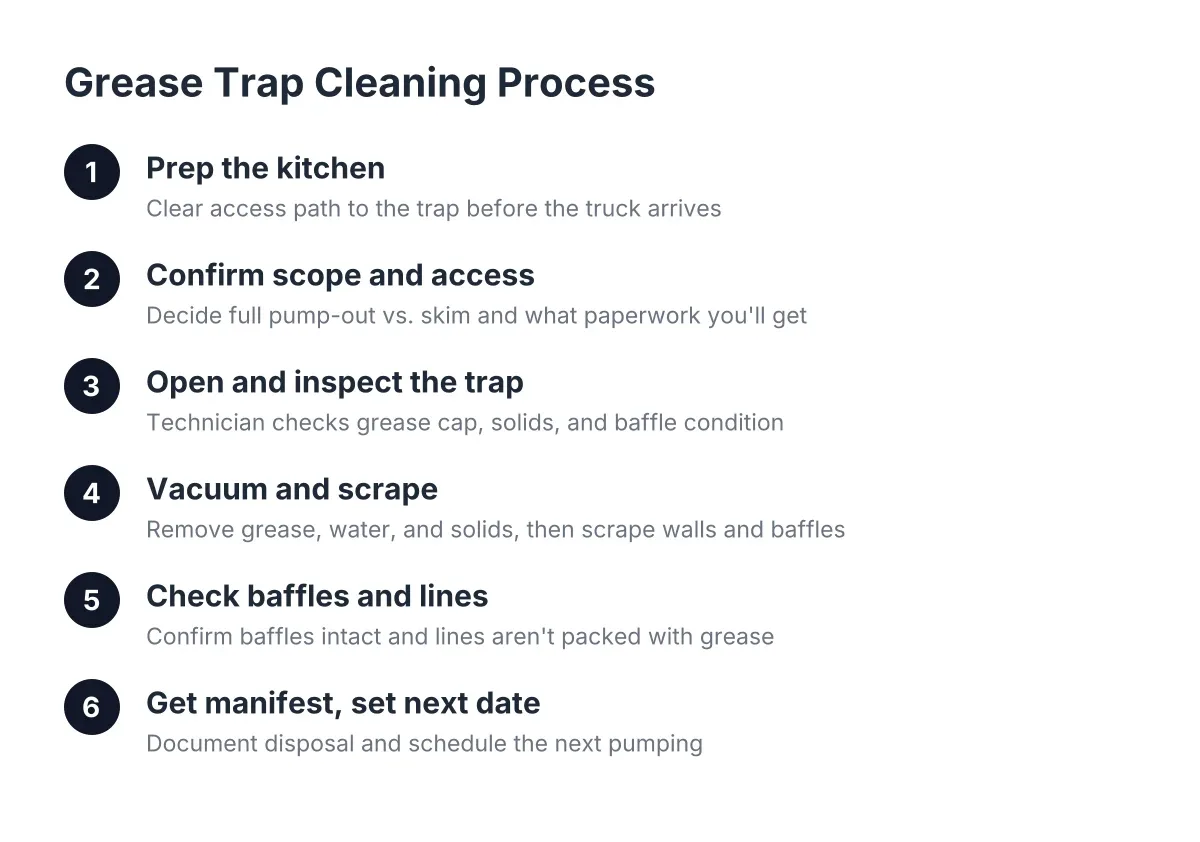
Step 1: Prep Your Kitchen Before the Truck Arrives
Before the crew shows up, clear a working path to the trap. For an indoor under-sink trap, that means moving mats, trash cans, and anything stored on or around the unit. For an outside in-ground interceptor, make sure the access lids are not blocked by a parked delivery van, a dumpster, or stacked patio furniture.
Schedule the visit for a slow window if you can. Pumping an indoor trap opens the unit and releases odor, so mid-morning before lunch prep or after close works better than the middle of a dinner rush. Most single-trap visits take somewhere between 30 minutes and a couple of hours depending on trap size and access, so plan staffing around that window.
In addition, pull your last service record if you have one. The crew can compare grease levels against the previous visit and tell you whether your current pumping interval is holding up or needs to tighten.
Step 2: Confirm the Scope, Access, and Documentation Up Front
When the technician arrives, walk them to the trap and confirm three things before any lid comes off: which unit is being serviced, whether it is a full pump-out or a partial skim, and what paperwork you will get afterward.
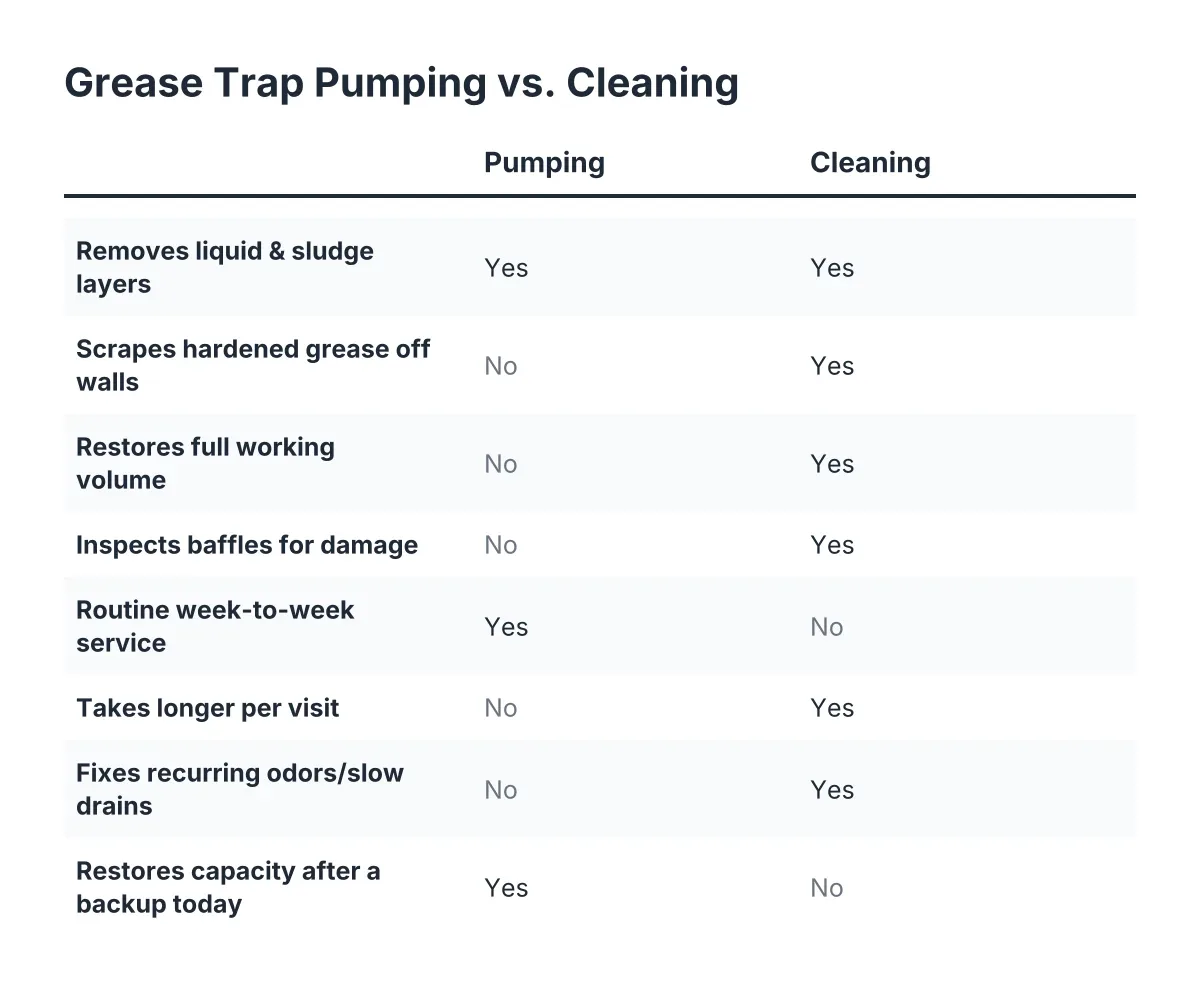
This matters because a full pump-out and a skim are not the same service. A skim removes the floating grease layer only. A full clean-out removes everything, including grease on top, water in the middle, and settled solids on the bottom, then scrapes the walls and baffles. For health inspection purposes, most kitchens need the full clean-out documented; a skim leaves solids behind that keep building.
Ask for the manifest or service receipt in writing. It should show the date, the volume removed, the disposal destination, and the company that did the work. Many health departments and sewer districts in California expect you to produce these records on request, so treat the paperwork as part of the service, not an afterthought.
Step 3: Understanding the Grease Trap Cleaning Process During Professional Service
Once the scope is set, the crew opens the trap and gets to work. The grease trap cleaning process begins when the technician removes the access lid and checks the condition of the trap before anything gets vacuumed. This first look tells them a lot: how thick the grease cap is, whether solids have piled up near the outlet, and whether the baffles are intact.
Next comes the actual removal. The vacuum truck hose pulls out the contents in layers, similar to how a septic tank separates: fats, oils, and grease float on top as a scum layer, solids settle to the bottom, and water sits in the middle. According to the U.S. Environmental Protection Agency, that layering is exactly how grease and solids behave in a septic tank as well, which is why the same trucks and crews handle both jobs. A septic tank pumping outfit serving Hesperia and the High Desert typically runs grease trap routes with the same equipment.
A thorough crew does not stop at vacuuming the liquid. They scrape hardened grease off the trap walls, clean the inlet and outlet baffles, and remove solidified chunks rather than leaving them to float back into the system. Grease that cools and hardens sticks to surfaces, so leaving a coated wall behind means the trap refills faster and clogs sooner.
Step 4: Have the Baffles and Lines Checked While the Trap Is Open
An empty trap is the only time anyone can see its parts clearly, so use it. Ask the technician to confirm the inlet and outlet baffles are present, attached, and not corroded through. A missing outlet baffle lets grease flow straight into your lateral line, and that is how a trap that "just got pumped" still causes a backup three weeks later.
However, if your drains were already slow before the visit, pumping the trap alone may not fix it. Grease clogs coat the inside walls of the pipe, so punching a small hole through the blockage with a snake gives you a week of relief before it closes up again. Clearing a grease-coated line for good usually takes a jetter or similar tool that cleans the full pipe wall. If the crew finds grease packed in the line past the trap, get that handled while everything is open rather than booking a second emergency visit later.
This is also the moment to ask honest questions about trap condition. Cracked concrete interceptors, rusted-out steel traps, and undersized units are structural problems that the grease trap cleaning process cannot solve. A trap that is too small for your kitchen's volume will fail inspection eventually no matter how often it gets pumped, and that call is worth a professional's judgment rather than a guess.
Step 5: Get the Manifest and Confirm Where the Grease Goes
The waste does not disappear when the truck leaves. It gets hauled to an approved disposal or treatment facility, the same way septic waste pumped from residential tanks is trucked to a treatment plant rather than processed on site, according to the New Hampshire Department of Environmental Services. Your manifest documents that chain, and it is your proof that the grease was disposed of legally rather than dumped.
Before the truck pulls away, check the paperwork for these items:
- Date and time of service
- Address and unit serviced
- Gallons or volume removed
- Whether it was a full pump-out or partial skim
- Disposal facility or destination
- Company name and contact information
File this with your other compliance records. Suppose a health inspector shows up at a Hesperia taco shop on a Tuesday and asks when the trap was last serviced; in that scenario, the owner who can hand over a dated manifest is done in two minutes, while the owner who says "a while ago, I think" is now on a re-inspection list. The document is cheap insurance.
Step 6: Set the Next Pumping Date Before You Forget
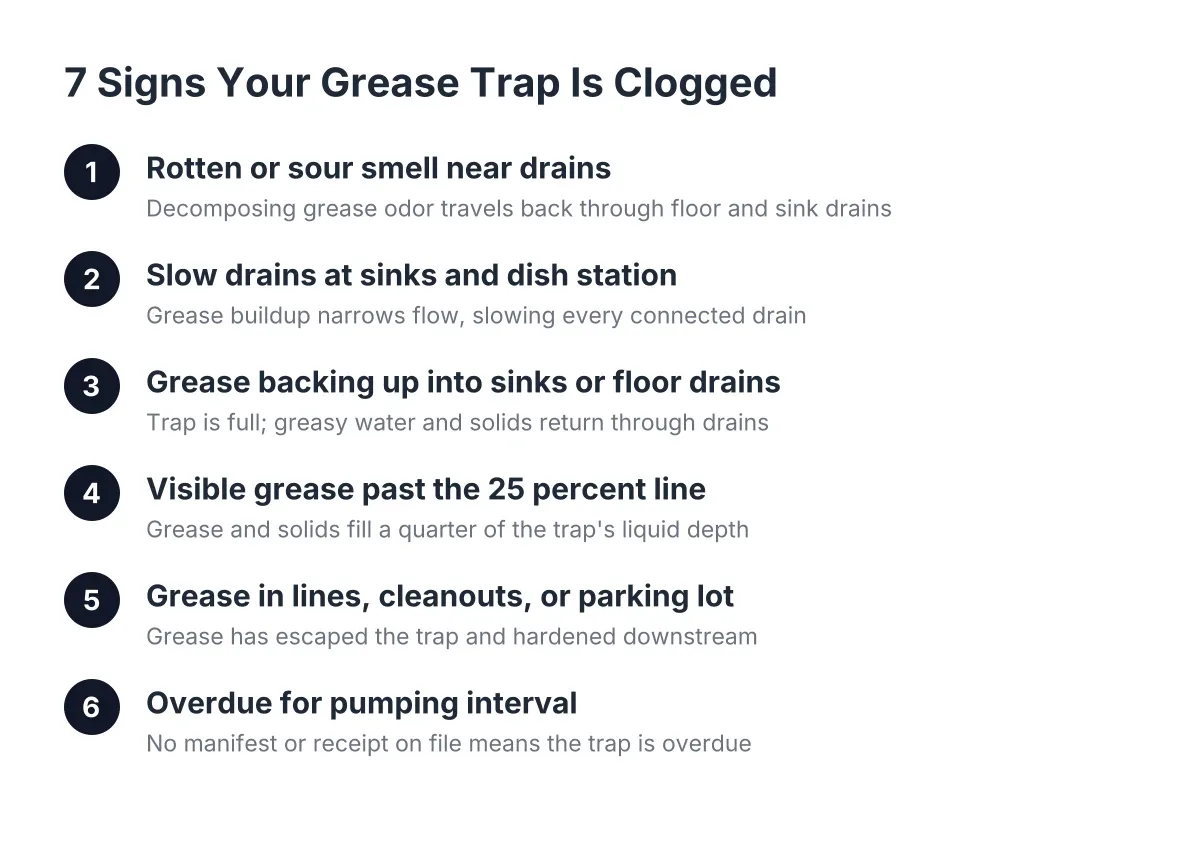
The best time to schedule the next visit is while the current one is fresh. Pumping frequency depends on your kitchen's volume; a high-output fryer operation fills a trap far faster than a coffee shop. A common rule inspectors use is servicing the trap once grease and solids fill about a quarter of its depth, and your technician can estimate how long that takes based on what they just pumped out.
For example, say a mid-sized diner gets its trap pumped and the crew finds the grease cap took three months to reach that quarter-full mark. In that case, a quarterly schedule fits, and stretching it to six months to save money invites slow drains, odors, and an inspection failure that costs far more than the skipped visit.
Between visits, cut what goes down the drain. Scrape plates into the trash, dry-wipe pans before washing, and never pour fryer oil into a sink. Reducing the grease that enters the trap in the first place is the single most effective way to stretch the interval between pump-outs.
What Professional Grease Trap Cleaning Process Accomplishes Compared to DIY Cleaning
What happens during professional grease trap service goes well beyond what a staff member with a bucket can do. The grease trap cleaning process employed by professionals removes all three layers, the walls and baffles get scraped clean, the waste is hauled to a legal disposal site, and you receive a manifest that satisfies an inspector. DIY scooping removes some surface grease, leaves the solids and wall coating in place, and produces no documentation at all.
There is one honest trade-off to weigh: professional service costs money on a recurring basis, and a small trap in a low-volume kitchen may need it less often than a sales rep might suggest. Track your own grease accumulation between visits and let the actual measurements set the schedule. When in doubt about frequency, sizing, or a trap that keeps backing up despite regular pumping, bring in a professional to inspect the system rather than guessing.
For kitchens in Hesperia and the surrounding High Desert, grease trap pumping is usually handled by the same local crews that run septic tank pumping routes, since the trucks, disposal process, and know-how overlap. The visit itself is straightforward. What separates a smooth compliance record from a scramble is the prep you do before the truck arrives and the paperwork you keep after it leaves.
If you need your septic tank serviced, Hesperia Septic can help.
Prefer to talk it through? Call (760) 249-7872 — a quick call is usually the fastest way to get a straight answer for your situation.