Enzyme Cleaners for Grease Traps: Do They Work, and When Should You Use Them?
Walk down the aisle of any restaurant supply store and you will find shelves of enzyme cleaners for grease traps promising to dissolve grease, kill odors, and stretch the time between pump-outs. If you run a commercial kitchen in Hesperia, or you own a rental property with a grease trap you just discovered during a walkthrough, those products look tempting. A jug of liquid is cheaper than a service truck. The question is whether enzyme cleaners actually do what the label says, and whether they can replace scheduled pumping when a health inspector or a backup is on the line.
The short answer: enzyme products have a real but limited role. They can help as maintenance between pump-outs. They cannot replace pumping, and in some situations they can make things worse downstream. This guide walks through how they work, where they fit, where they fail, and how to decide what your kitchen or rental property actually needs.
Why Grease Traps Exist in the First Place
A grease trap sits between a kitchen's sinks and the sewer or septic line. Its job is simple: slow the wastewater down so fats, oils, and grease (often shortened to FOG) can separate out before they reach the pipes beyond.
The physics inside a trap mirror what happens in a septic tank. According to the U.S. Environmental Protection Agency, fats, oils, and grease float and form a scum layer on top, solids sink to form a sludge layer on the bottom, and the liquid in the middle, called effluent, flows out. The trap holds back the top and bottom layers and lets the middle layer pass.
The volume involved surprises most owners. A single restaurant can release between 800 and 17,000 pounds of grease into the sewer system each year, according to Wastewater Digest. That is why health departments and sanitation districts take trap maintenance seriously. Grease from restaurants, homes, and industrial sources is the most common cause of reported sewer blockages, responsible for 47 percent of cases, according to the U.S. Environmental Protection Agency.
When a trap fills past its working capacity, grease escapes into the line. Grease clogs behave differently than paper clogs. Grease coats and hardens on the interior walls of the pipe, so snaking a hole through the blockage does not fix the problem; the coating stays, and the line re-clogs. That is the failure mode enzyme products claim to prevent.
How Enzyme Cleaners for Grease Traps Actually Work
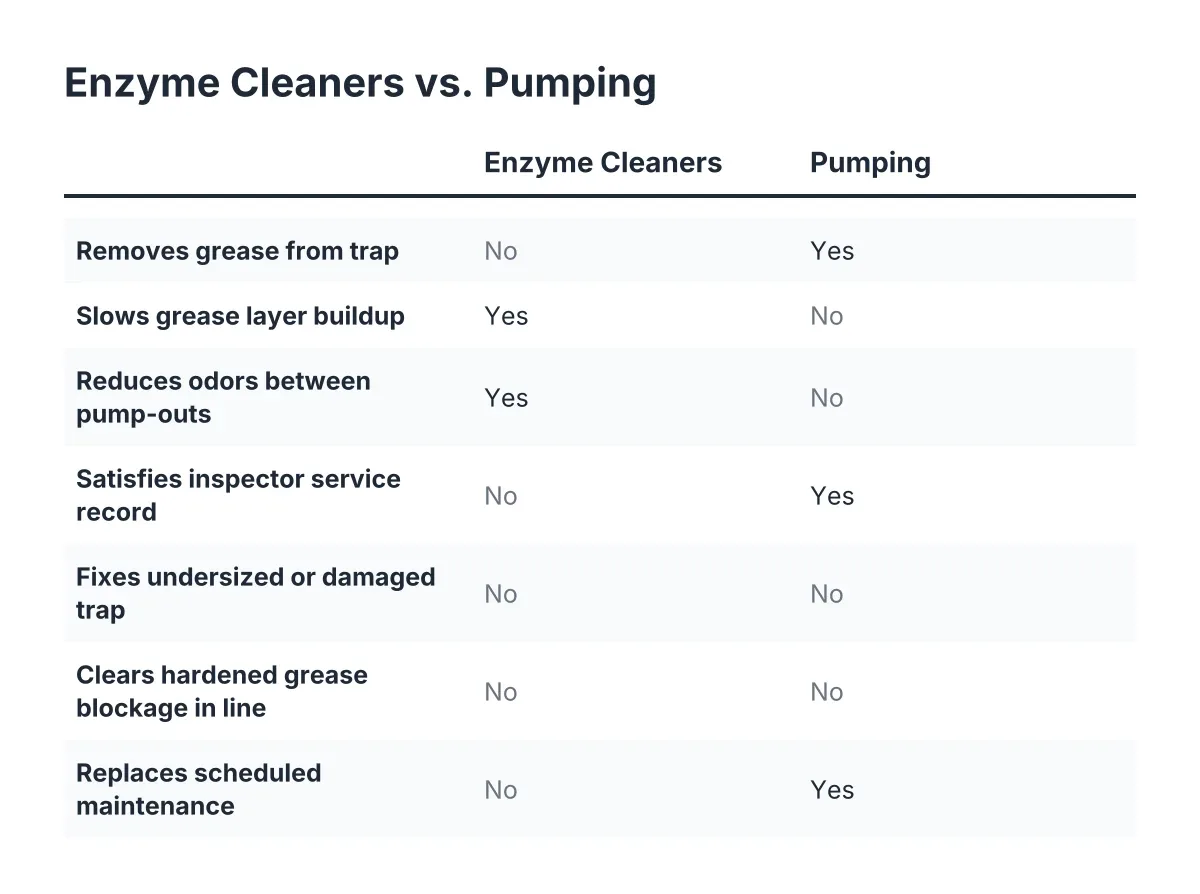
Enzyme cleaners for grease traps work by breaking large fat molecules into smaller compounds that bacteria can digest, or by adding live bacteria that produce those enzymes on site. Used regularly, they can slow the buildup of the floating grease layer and reduce odors. What they do not do is remove grease from the trap; they change its form, and some of it moves downstream.
That distinction matters more than any marketing claim. A trap is designed to hold grease so a service truck can haul it away. An additive that liquefies grease can push it past the trap and into the sewer line or septic system, where it cools, hardens, and causes the exact blockage the trap was supposed to prevent. This is why some sewer districts restrict or discourage certain additives, and why you should check local rules before dosing a trap that discharges to a municipal line.
There is also the question of evidence. Commercial additives marketed to decompose or dissolve sludge lack strong scientific backing, according to research from several university extension programs cited by Washington State University Extension. That research focused on septic tanks, but the biology is the same: additives supplement what bacteria already do; they do not empty a tank.
What an Enzyme Cleaner Can Realistically Do
Used as directed, usually a monthly or weekly dose down the drain, an enzyme cleaner can:
- Slow the rate at which the floating grease layer thickens between pump-outs
- Reduce the sour, rancid odor that comes off an aging trap
- Keep drain lines between the sink and the trap flowing more freely
- Help restore bacterial activity after something disrupted it, such as a heavy dose of sanitizer or bleach down the drain
What No Additive Can Do
However, no enzyme or bacteria product can:
- Remove accumulated grease and solids from the trap; only pumping does that
- Substitute for a pump-out record when a health inspector asks for one
- Fix a trap that is undersized, damaged, or piped wrong
- Clear a hardened grease blockage in the line past the trap
The common misconception is that steady additive use eliminates the need for regular pump-outs. It does not. Additives are a supplement between pump-outs, nothing more. If a product sales pitch tells you otherwise, treat that as a warning sign about the product.
The Compliance Problem Enzyme Products Cannot Solve
Here is the part that matters most if you operate a restaurant or lease to one. Health inspectors and sanitation districts do not ask whether you pour an enzyme cleaner down the drain. They ask when the trap was last pumped, who pumped it, and where the paperwork is.
Grease trap health inspection requirements vary by jurisdiction, but the pattern is consistent: regulators want to see a service record from a licensed hauler showing the trap was pumped on a schedule and the waste went to an approved disposal site. A receipt for a gallon of enzyme cleaner does not satisfy that requirement anywhere.
Suppose you own a small strip-mall unit in Hesperia leased to a taco shop. The tenant has been dosing the trap with an enzyme product for two years and never scheduled a pump-out, because the drains kept flowing and the additive seemed to work. Then an inspection or a sewer backup forces the question, and there is no service record to show. In that scenario, the owner faces a possible citation, an emergency grease trap pumping call at the worst possible time, and a tenant dispute over who pays. A standing pump-out schedule with documented receipts would have cost less than the cleanup.
For a landlord with one to five septic-served or trap-equipped units, the documentation is the asset. A file of dated pump-out manifests protects you during a sale, a lease dispute, or a county inquiry. An empty jug of additive protects nothing.
Grease Trap vs. Grease Interceptor: Why Size Changes the Answer
The right role for additives also depends on which device you have. A grease trap is the small unit, often under a three-compartment sink, holding a modest volume. A grease interceptor is the large in-ground tank outside the building, often holding hundreds or thousands of gallons.
For small under-sink traps, manual cleaning plus occasional enzyme maintenance between cleanings is a workable routine for a low-volume kitchen. The trap is accessible, the volume is small, and staff can scoop and scrape it on a schedule.
For in-ground interceptors, additives matter even less. The tank holds too much material for a dosed product to meaningfully change, and most jurisdictions set mandatory pumping intervals for interceptors regardless of what you pour in. Pumping frequency is driven by how fast your kitchen produces grease, which depends on menu, volume, and dishwashing habits. A fryer-heavy kitchen fills a trap far faster than a coffee shop.
If you are a buyer looking at a commercial property with no records, you may not even know which device you have, or where it is. That is the same blind spot rural land buyers face with hidden septic tanks. A locating and inspection visit answers the question before you commit money: a crew finds the trap or interceptor, opens it, measures the grease and solids layers, and gives you a written picture of its condition. On a purchase in escrow, that report is worth more than any additive on the market.
When Enzyme Cleaners for Grease Traps Make Sense
Enzyme cleaners for grease traps make sense as a maintenance layer in three specific situations: between scheduled pump-outs to slow buildup, after a disruption kills off the trap's natural bacteria, and in low-volume kitchens where odor control between cleanings is the main complaint. In each case the additive supports the pumping schedule; it never replaces it.
Work through the decision like this:
- Confirm your pump-out schedule first. If the trap is not on a documented pumping schedule, fix that before spending anything on additives. The schedule is the compliance requirement; the additive is optional upkeep.
- Check local rules. Some sanitation districts restrict additives that liquefy grease into the sewer. If your building discharges to a septic system instead of a sewer, be even more cautious, because liquefied grease that reaches a drain field can clog it.
- Match the product to the problem. Odor between services points to an enzyme or bacteria maintenance dose. Slow drains or visible grease at the trap outlet point to a full trap that needs pumping now, not dosing.
- Watch for disrupted bacteria. If heavy sanitizer use or a deep-clean wiped out the trap's biology, a bacterial additive to re-seed it is one of the few cases where most professionals agree an additive earns its cost.
- Keep receipts for both. Log additive use alongside pump-out manifests. If a dispute or inspection comes up, you can show the full maintenance story.
The same logic applies to septic systems, by the way. Monthly enzyme or bacteria packets can help break down paper and reduce sludge buildup in a septic tank, but they supplement bacteria between pump-outs rather than replacing septic tank pumping. Owners who hear "never pump again" claims should be skeptical in both contexts.
Signs the Trap Needs Pumping, Not Another Dose
No additive fixes a full trap. Call for service instead of reaching for the jug when you see:
- Water backing up or draining slowly at kitchen sinks, especially after the dish rush
- A strong rancid smell near floor drains or the trap lid that returns within a day of cleaning
- Visible grease in the line or cleanout past the trap
- A grease layer in the trap approaching a quarter of its depth
- Any sewage backup, which can also involve the septic system itself if the property is not on sewer
That last point matters in the High Desert, where many Hesperia properties run on septic rather than municipal sewer. On a septic property, a failing grease trap sends grease into the septic tank, where it thickens the floating scum layer and shortens the time between septic pump-outs. During a septic inspection, floating globs of kitchen grease in the tank are a telltale sign the kitchen's grease handling has failed upstream; a crew scoops them out and disposes of them in the trash rather than leaving them in the system.
What Professional Grease Trap Service Includes
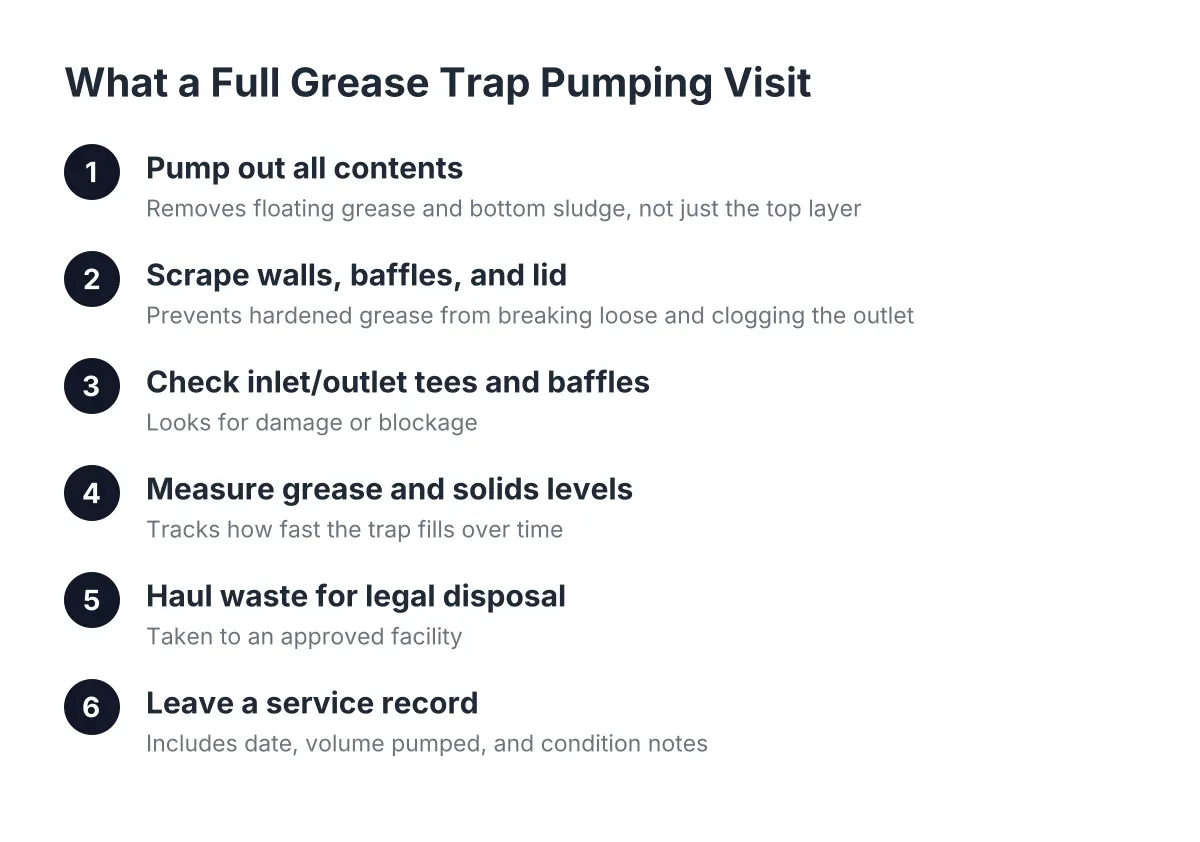
A legitimate service visit does more than suck out liquid. A typical crew will pump the full contents of the trap or interceptor, including the floating grease layer and the settled solids on the bottom, scrape the walls and baffles where hardened grease clings, check that inlet and outlet fittings are intact, and haul the waste to an approved disposal facility. You should receive documentation showing the date, the volume removed, and the disposal destination.
Line jetting past the trap, repairs to damaged baffles or lids, and locating a buried or unmarked unit are usually separate line items, so ask up front what the quote covers. Turnaround for a routine trap service is generally a same-day visit measured in hours, not days, though access problems or a buried lid can extend that; treat any timeline as an estimate until a crew sees the site.
On cost, no honest provider quotes a firm number sight unseen, because trap size, access, and condition drive the price. For context on the related service, septic tank pumping averages $427, ranging from $250 to $1,250 or more depending on tank size and location, according to Angi data. Grease trap work follows the same logic: small under-sink traps cost less to service than large in-ground interceptors, and a neglected trap full of hardened grease costs more than one on a regular schedule.
Choosing a Provider, and the Three Questions to Ask
Grease trap pumping is a natural fit for septic-focused companies, since the trucks, tanks, and disposal relationships are the same ones used for septic work. In Hesperia and the surrounding High Desert, that often means the crew that handles your septic tank can handle your grease trap on the same visit, which simplifies scheduling for a landlord juggling several properties.
Before you book, ask three things:
- Will I get documentation I can show an inspector or a buyer? The answer must be yes, with a written service record every visit.
- Where does the waste go? A legitimate hauler names the approved disposal facility. For comparison, pumped septic waste is transported by truck to a treatment plant rather than handled on site, according to the New Hampshire Department of Environmental Services, and grease waste follows a similar regulated path.
- What does the quote include? A fair quote covers full pump-out of all layers, scraping, and disposal. Vague quotes that only mention "pumping" sometimes mean the solids stay behind.
One honest limitation: if your trap is undersized for the kitchen's output, or if a line past the trap is already coated with hardened grease, pumping alone will not end the problem, and no additive will either. That situation calls for an on-site assessment by a professional, and possibly a plumber for re-piping or trap replacement. Likewise, if your property is on septic and you do not know the tank's location or condition, get it located and inspected before you invest in any maintenance plan.
The Bottom Line on Additives vs. Pumping
Treat enzyme cleaners for grease traps the way you would treat oil additives in a work truck: reasonable upkeep, useless as a substitute for the real service. The pumping schedule and the paper trail are what keep a kitchen open, a tenant compliant, and a property sale clean. An enzyme cleaner can make the stretch between pump-outs smoother; it cannot make that stretch infinite, and as of 2026 no health department accepts it as proof of maintenance.
If you own or are buying a Hesperia property with a grease trap, a septic system, or both, start with the basics: find out where everything is, get it opened and inspected, and put it on a documented service schedule. When you are ready to do that, reach out to a local Hesperia septic and grease trap service to get the trap located, assessed, and on a pumping schedule that will hold up to any inspection.
If you need your septic tank serviced, Hesperia Septic can help.
Prefer to talk it through? Call (760) 249-7872 — a quick call is usually the fastest way to get a straight answer for your situation.