Septic Tank Cost in Hesperia, CA: Honest Pricing for Pumping, Inspections, and Locates
If you are trying to pin down the septic tank locating cost and other expenses before you call anyone, you are doing it right. Most people in Hesperia, CA only think about their septic system when something goes wrong, and that is exactly when a confusing quote can catch you off guard. This guide walks through what pumping, cleaning, inspections, and emergency visits actually involve, what drives the price up or down, and how to tell whether a quote you already have is fair. No mystery fees, no manufactured upsells, just the information you need to make a decision.
This matters even more if you just bought land in the High Desert, or you are about to, and nobody can tell you where the tank is or when it was last serviced. You are not alone in that situation. According to the U.S. Environmental Protection Agency, more than one in five U.S. households depend on individual septic systems or small community cluster systems to treat their wastewater. Plenty of those properties change hands with zero paperwork.
What Septic Tank Pumping Costs and Why the Range Is So Wide
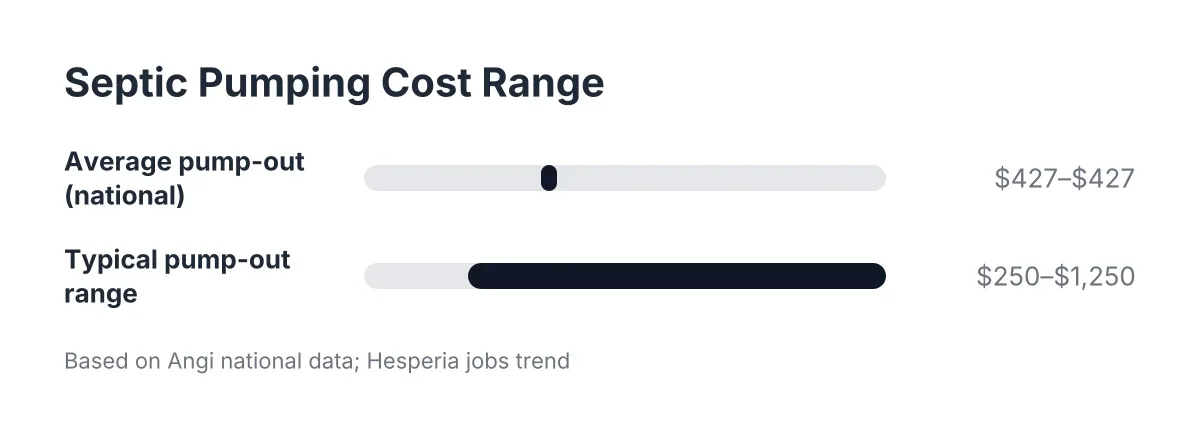
Septic tank pumping costs vary more than most homeowners expect, because the price depends on the tank, the site, and the condition of the system, not just the service itself. According to Angi data, septic tank pumping averages $427 nationally, with a range from $250 to $1,250 or more depending on tank size and location. That wide spread is not a company being vague. It reflects real differences from one property to the next.
Here is why two neighbors in Hesperia can pay different amounts for the same basic service:
- Tank size. A larger tank holds more waste, takes longer to pump, and fills more of the truck. Bigger tank, bigger bill.
- Access. A tank with risers at grade level is fast to open. A tank buried under two feet of hard-packed desert soil requires digging before the hose ever goes in.
- How full and how compacted the tank is. A tank pumped on schedule empties quickly. A tank that has gone a decade without service may have a thick, hardened sludge layer that takes extra time and effort to remove.
- Distance and disposal. Pumped waste does not vanish at the curb. According to the New Hampshire Department of Environmental Services, septic waste pumped from residential tanks is transported by truck to a sewage treatment plant for disposal. Hauling and disposal are built into every honest quote.
- Local supply and demand. Pricing in any area reflects how many pump trucks operate there relative to the number of septic-served homes. The High Desert has its own market, and quotes here will not match quotes from Texas or Arizona.
When you get a quote in Hesperia, ask what tank size it assumes, whether digging is included, and whether disposal fees are part of the number. A company that answers those three questions plainly is quoting you honestly. A company that dodges them is leaving room to add charges later.
Pumping vs. Cleaning: Two Services, Two Price Points
People use "pumping" and "cleaning" interchangeably, but they are not always the same job, and the price can differ. Pumping removes the liquid and most of the solids through the access lid. Cleaning goes further; the crew breaks up and removes the compacted sludge layer on the bottom and the hardened scum on top, often using water from the tank itself to agitate the material.
Therefore, the cost of septic tank locating and pumping or cleaning services usually varies, because cleaning takes more time and more work. A well-maintained tank pumped every few years may never need the heavier service. A neglected tank almost always does. This is one of the clearest financial arguments for staying on a schedule; routine pumping is the cheap visit, and the cost to maintain a system is a fraction of the cost to rescue one.
For an active family of four, pumping the tank every two to three years is generally advisable because of the higher volume of solids and liquid the household produces, according to Penn State Extension. Smaller households can often go longer. A local crew that sees your tank can tell you where you fall.
What a Septic Inspection Costs, and When It Is Worth Paying For
A septic system inspection in the Hesperia area is typically a few hundred dollars or less, and it is the single most useful purchase you can make before buying property with an unknown system. The inspector checks the tank's structure, the baffles, the liquid levels, and the condition of the system overall, then documents what they find. For context, a conventional system has two main components, the septic tank and the drain field, according to the U.S. Environmental Protection Agency, and a real inspection looks at the health of both.
However, there is a practical wrinkle worth knowing. An inspection often costs close to what a pump-out costs, because both require a truck, a crew, and an open tank. For that reason, many owners combine the two: pump the tank and inspect it in the same visit. The inspector sees the empty tank's walls and baffles clearly, and you get two jobs done for less than two separate trips. If you are deciding between an inspection-only visit and a pump-and-inspect visit, the combined option usually delivers more value per dollar.
The EPA recommends that the average household have its septic system inspected at least once every three years by a professional. If you cannot remember your last inspection, or you never had one because you inherited the system with the house, 2026 is a fine year to start the clock.
Buying Land With No Records? Budget for a Septic Tank Locating Cost First
If there is no visible lid, no riser, and no paperwork, the first line item involves septic tank locating and cost estimation. The crew finds the tank, marks it, and exposes the lid so the system can be pumped and inspected. Locating is usually a modest add-on to a service visit, but it can grow if the tank is deep or the lid is buried under landscaping, concrete, or years of compacted soil.
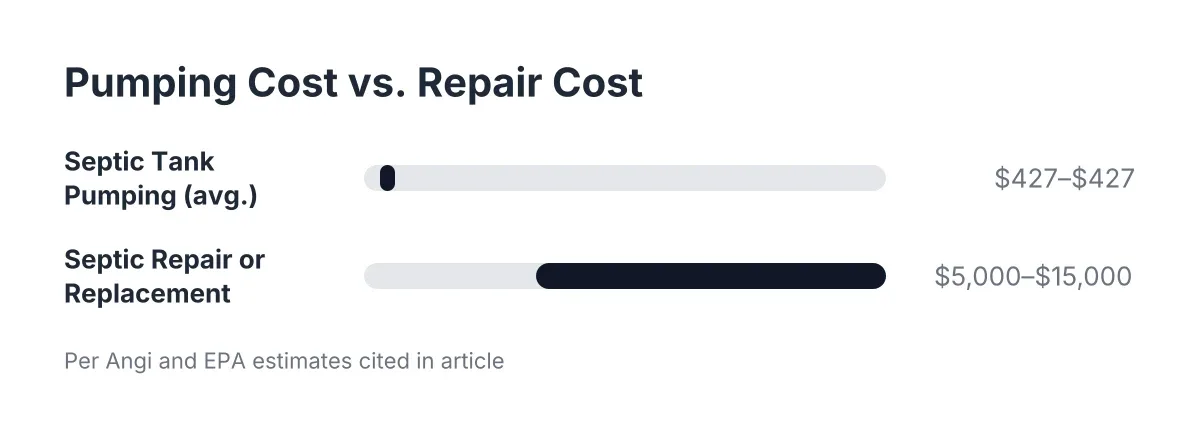
Suppose you are in escrow on a two-acre parcel outside Hesperia. The seller shrugs when you ask about the septic, and there is nothing on the lot but dirt and creosote. In that scenario, a realistic plan looks like this: a locate to find and mark the tank, a pump-out so the inspector can see the tank's interior, and a written report on the tank and drain field condition. All together, that is typically a few hundred to roughly a thousand dollars depending on digging and tank condition, as a rough illustrative estimate. Compare that to the alternative. According to the U.S. Environmental Protection Agency, septic repair or replacement typically costs between $5,000 and $15,000. Spending a few hundred dollars to avoid inheriting a five-figure problem is one of the easiest calls in real estate.
Worried a locate-and-inspect delays escrow? It is a single visit in most cases, and the written report often moves a stalled negotiation forward. If the system turns out to be bad, you want that leverage before closing, not a surprise after.
If Access Is the Problem, Risers Pay for Themselves
Here is a pattern worth knowing before your second pump-out. When a tank has no risers, the crew has to dig to reach the lids on every single visit, and that digging adds cost every single time. At some point, the math flips; installing risers once costs less than paying for excavation repeatedly. If your quote includes a digging charge, ask what risers would run. It is the opposite of an upsell. It is the one add-on that lowers every future bill.
Emergency Septic Service Costs More, and Here Is the Honest Reason
Emergency septic pumping costs more than scheduled service because it compresses everything into right now. A backup on a Saturday night means a truck and crew outside normal routing, and the job often involves a tank that is overfull, a line that is blocked, or sewage already where it should not be. Backup and overflow response takes longer than a routine pump-out, and the pricing reflects that reality, not a penalty for bad luck.
The better play, when you have the choice, is to never need the emergency rate. Slow drains, gurgling pipes, odors near the tank, and wet spots over the drain field are all early warnings. A scheduled pump-out at the first sign costs a fraction of a weekend overflow call plus cleanup. In addition, watch your water use. According to the U.S. Environmental Protection Agency, a single leaky or running toilet can push as much as 200 gallons of extra water per day into a septic system. That is a quiet way to flood a drain field and turn a maintenance item into an emergency.
How to Tell If a Septic Quote in Hesperia, CA Is Fair
A fair septic quote is itemized, specific to your property, and free of vague line items. You do not need to be a septic expert to evaluate one. You need the right questions. Before you say yes to any company in Hesperia, CA, run the quote through this list:
- Does the price state a tank size or gallon assumption? If the quote is "starting at" a number with no size attached, the final bill is a mystery.
- Is digging included or extra? If your tank has no risers, excavation is a legitimate cost, but it should be named upfront, not discovered on the invoice.
- Are disposal fees included? Hauling waste to a treatment plant is part of the job. Honest quotes build it in or state it separately; they do not spring it on you.
- Is the crew pumping both compartments? Many tanks have two compartments, and pumping only one leaves half the job undone at full price.
- What triggers an extra charge? Heavy sludge, a hard-to-find tank, or a collapsed lid can all legitimately add cost. A good company tells you the triggers before the truck arrives.
- Does the quote push repairs before anyone has opened the tank? Baffle replacements, additive treatments, and filter sales pitched sight unseen are red flags. Real recommendations come after the lid is off.
A note on baffles, since they show up in upsell pitches: they are real and they matter. Septic tanks use a baffle at both the inlet and outlet that stops solids from floating out and forces them to settle, which keeps the drain field protected, according to University of Nebraska-Lincoln Extension. A failed baffle is worth fixing. A baffle "replacement" quoted before anyone has looked inside your tank is worth questioning.
Where Pumping Fits in the Bigger Septic Tank Cost Picture
Pumping is the small number in the septic world. The big numbers belong to installation and replacement, and understanding that gap is what makes routine service an easy decision. Septic tank cost to install or replace depends on factors that have nothing to do with pumping: soil conditions, trench depth, rock in the ground, the layout of the site, and whether the system needs a pump. A system going into gentle, sandy ground with shallow trenches costs far less to build than one that requires deep excavation or rock removal, and High Desert soil varies lot by lot.
Material matters too. Concrete tanks are common, and tank shapes vary by region; some areas use rectangular concrete tanks while others use circular designs, according to the International Code Council. Concrete tanks are often cheaper than poly tanks of the same size, which is one reason so many existing tanks around Hesperia are concrete.
Here is the comparison that should drive your maintenance decisions. Routine pumping sits in the hundreds. Repair or replacement, per the EPA figure cited earlier, sits between $5,000 and $15,000. Every skipped pump-out pushes solids toward the drain field, and the drain field is the expensive half of the system. Once wastewater leaves the tank, it flows through perforated lateral pipes into the absorption field and filters through gravel, sand, and soil, according to the U.S. Environmental Protection Agency. Solids that escape a neglected tank clog that field, and a clogged field is a replacement conversation, not a pumping one. The whole point of tracking septic tank cost is realizing that the cheapest line on the menu, scheduled pumping, is the one that protects you from the most expensive line.
One honest limitation: no article can price your specific tank sight unseen, and any company that quotes a firm final number without knowing your tank size, access, and condition is guessing. Use the ranges here to sanity-check quotes, and let an on-site visit set the real number. If your system shows signs of drain field failure, such as standing water or sewage surfacing in the yard, skip the pricing research and get a professional out to look; that situation needs eyes on site, not estimates.
What a Straightforward Service Visit Looks Like in Hesperia
Knowing the process removes the last of the uncertainty. For a typical pump-out in Hesperia, here is how an illustrative visit goes. The crew confirms the tank location, or performs a locate if nobody knows where it is. They expose the lids, note the liquid levels before pumping, and then pump the tank, breaking up the sludge layer so it actually leaves with the truck. They check the baffles and the tank's visible condition while it is empty, tell you what they found in plain language, and haul the waste to a treatment facility for disposal.
For a land buyer with no records, add one step at the start, the locate and mark, and one at the end, a written report you can hand to your lender, the county, or the seller's agent. That document is what turns an unknown system into a known quantity, and it is the difference between negotiating from facts and hoping for the best.
The pattern across every scenario in this guide is the same. Scheduled service is predictable and cheap. Deferred service is unpredictable and expensive. Whether you are a longtime Hesperia homeowner keeping a three-year rhythm or a buyer staring at a bare lot with no lid in sight, the money favors knowing your system now, on your schedule, at the routine rate.
If you need your septic tank serviced, Hesperia Septic can help.
Prefer to talk it through? Call (760) 249-7872 — a quick call is usually the fastest way to get a straight answer for your situation.