Septic Tank Cost in Hesperia: What Pumping, Cleaning, and Inspections Really Run
If you're trying to pin down the septic pumping cost in Hesperia before you call anyone, you're doing it right. Most people in Hesperia put off pumping for the same reason: they don't know what a fair price looks like, and they're worried a company will show up and "find" problems that don't exist. This guide breaks down what septic service actually costs, what drives the price up or down, and how to tell a fair quote from a padded one, so you can schedule the work without feeling like you're guessing.
One note before we start. This article covers pumping, cleaning, inspection, and emergency service costs, which is what most Hesperia homeowners and small business owners actually need. If you're pricing a brand-new system installation or a full tank replacement, that's a different project with different numbers, and we touch on it only for context.
Why Septic Tank Costs Feel So Hard to Pin Down
Septic pricing confuses people because the same words mean different things from company to company. One outfit's "pumping" includes locating the tank and digging to the lid. Another's quote covers only the pump-out itself, and everything else shows up as a line item after the truck arrives.
There's also a supply-and-demand factor. Pump-out pricing in any area depends on how many trucks operate there relative to the number of septic-served homes. The High Desert has plenty of properties on septic, which keeps the market active, but prices still vary from one company to the next based on travel distance, disposal fees, and how they structure their quotes.
For context on how common this is: more than one in five U.S. households depend on individual septic systems or small community cluster systems to treat their wastewater, according to the U.S. Environmental Protection Agency. You're not dealing with a niche service. There's a real market here, and you can comparison shop the same way you would for any other home service. You just need to know what's inside each quote.
Septic Pumping Cost Factors in Hesperia
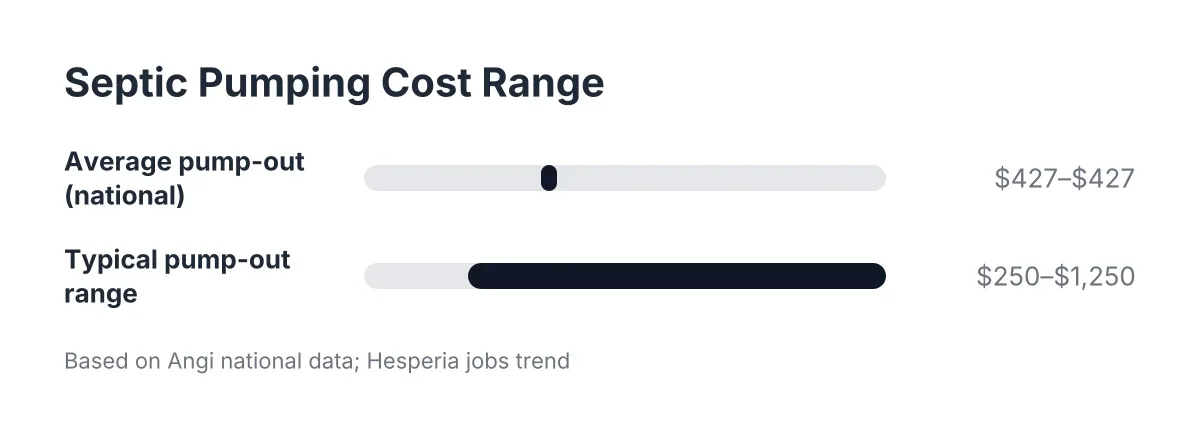
Septic tank pumping averages $427 nationally, with a typical range of $250 to $1,250 or more depending on tank size and location, according to Angi data. Most routine residential pump-outs in a market like Hesperia land toward the lower-to-middle part of that range when the tank is easy to find and access. Understanding septic pumping costs in Hesperia requires knowing what factors drive pricing in your area.
That spread is wide, so it helps to understand what pushes a job toward either end. A straightforward pump-out means the crew arrives, the lids are accessible, the tank is a common residential size, and the truck can park within hose reach. Each thing that breaks from that picture adds cost.
Here are the main factors that affect septic pumping price:
- Tank size. A larger tank holds more waste, takes longer to pump, and costs more to dispose of. A typical residential tank runs around a thousand gallons, but sizes vary.
- Access. If the lids are buried and nobody knows where, the crew has to locate the tank and dig. Hand-digging through packed High Desert soil takes time, and time costs money.
- Distance from the truck. Long hose runs or difficult parking can add a charge.
- How full or compacted the tank is. A tank that hasn't been pumped in many years may have a thick, hardened sludge layer that takes extra work to break up and remove.
- Disposal fees. Pumped waste doesn't vanish. It's transported by truck to a treatment facility for disposal, as the New Hampshire Department of Environmental Services describes, and those disposal costs get built into your price.
One practical note on access. When a tank has no risers and sits deep, the digging charge on every single visit can add up fast. In that situation, paying once to install risers often costs less over a few pumping cycles than paying dig fees every time. It's one of the few upsells that usually works in the homeowner's favor, so don't dismiss it automatically.
Pumping vs. Cleaning: Two Prices, Two Jobs
People use "pumping" and "cleaning" interchangeably, but companies sometimes price them differently, and it matters when you compare quotes. The cost difference between these services reflects the work involved: basic pumping removes liquids, while cleaning includes sludge removal and tank inspection.
Pumping means removing the liquid and solids from the tank. Cleaning usually goes further: breaking up the compacted sludge at the bottom, washing down the tank walls, and making sure the baffles are clear. Baffles are the fittings at the tank's inlet and outlet that stop solids from floating out toward the drain field; according to University of Nebraska-Lincoln Extension, they force solids to settle to the bottom, which keeps the whole system working.
Septic tank cleaning costs more than a basic pump-out because it takes more time on site. If a quote seems unusually cheap, ask whether it includes removing the solids and sludge or just the liquid. Pumping only the liquid out of a tank, sometimes called skimming, leaves the sludge behind and means you'll need service again much sooner. That cheap quote can end up being the expensive option.
What a Septic Inspection Costs and When It's Worth Paying For
A septic inspection typically costs in the same general range as a pump-out, sometimes less for a basic visual check and more for a full assessment with the tank opened and emptied. For most Hesperia homeowners, the smart move is combining inspection with pumping in one visit, because the tank has to be open and empty for a real inspection anyway. When you bundle inspection services with septic pumping costs in Hesperia, you gain both information and savings in a single appointment.
This matters for anyone who just bought a house and has no idea when the tank was last serviced. Paying for an inspection-only visit, then paying again for pumping a month later, roughly doubles your cost for the same information. A pump-out with the crew checking baffles, lids, and liquid levels while they're in there gives you both answers in one trip.
The EPA recommends having your septic system inspected at least once every three years by a professional. If you're buying property, an inspection before closing is a separate and worthwhile expense; it's one of the few times paying for inspection alone makes clear sense, because you need the answer before you own the problem.
Emergency Septic Service Costs More, and Here's the Math
Emergency septic pumping costs more than scheduled service. After-hours calls, weekend calls, and backup situations where the crew has to respond fast all carry a premium. Nobody enjoys paying it, but the premium is not the expensive part.
The expensive part is what an emergency usually means. Sewage backing up into a shower drain or pooling in the yard often signals that the tank overfilled and solids pushed into the drain field. A conventional septic system has two main components, the tank and the drain field, according to the U.S. Environmental Protection Agency, and the drain field is the part you cannot pump your way out of damaging.
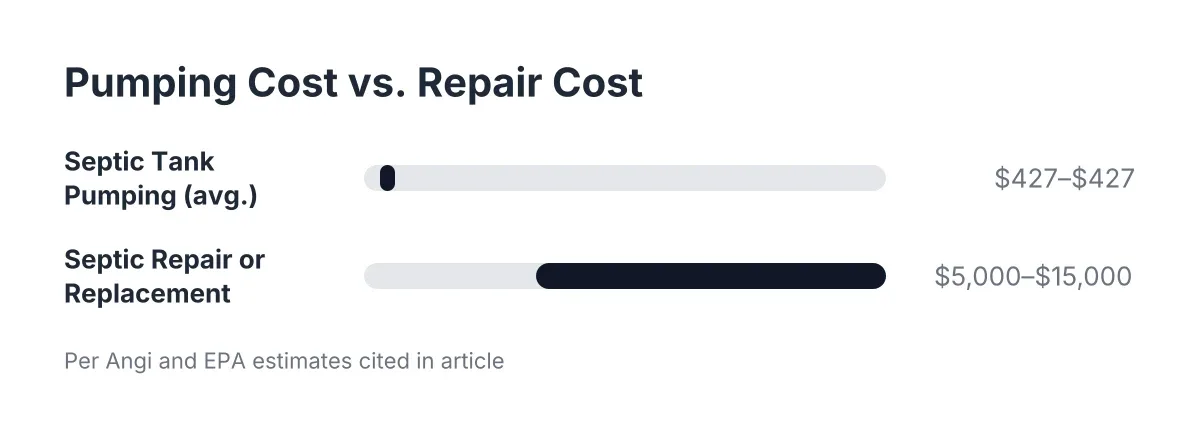
Here's the number that should drive your planning: the EPA estimates septic repair or replacement typically costs between $5,000 and $15,000. Compare that to a few hundred dollars for routine pumping. Every emergency call you prevent by staying on a schedule protects you from the five-figure scenario, not just the after-hours fee.
Water habits matter here too. According to the U.S. Environmental Protection Agency, a single leaky or running toilet can push as much as 200 gallons of extra water per day into a septic system. That constant flow can flood a tank and drain field faster than any pumping schedule can keep up with, so fixing a running toilet is one of the cheapest pieces of septic maintenance you'll ever do.
A Realistic Hesperia Scenario: Comparing Septic Pumping Cost Quotes
Suppose a homeowner in Hesperia bought a place two years ago. The inspector mentioned the septic system at closing, nothing seemed wrong, and the whole thing got filed under "later." Now a neighbor just had sewage come up in their yard, and later has arrived. The homeowner calls around and gets two quotes for septic pumping costs in Hesperia.
Quote A is $295 flat. Quote B is $385 and itemized: pump-out of a tank up to a stated size, locating the tank, digging to one lid, a baffle and lid check, and disposal included. These numbers are illustrative, not anyone's actual rates, but the pattern is real.
On paper, Quote A wins. On the phone, the homeowner asks three questions. Does $295 include locating and digging if the lids are buried? Does it include removing solids and sludge, or liquid only? Is disposal included? If the answers are no, no, and "there's a fee," Quote A can pass Quote B before the truck leaves the yard. In that scenario, the itemized quote was the honest one all along.
That's the whole method. The lowest headline number tells you nothing. The itemized quote tells you everything, and a company willing to itemize before arriving is showing you how they do business.
Questions That Separate Fair Quotes From Padded Ones
Ask these before any crew comes out, whether you're a homeowner or a business owner pricing grease trap or holding tank service:
- What does the base price include? Pump-out only, or locating, digging, and disposal too?
- Does the price change by tank size, and how is size confirmed? A fair company tells you how they measure, not just that they do.
- Do you remove solids and sludge, or just liquids? This is the skimming question, and it's the one that catches the lowball quotes.
- What are the access charges? Buried lids, long hose runs, and hard digging should have stated rates, not surprise ones.
- What would make the price go up once you're on site? The answer tells you whether surprises are the exception or the business model.
- For recurring service, is there a scheduled-account rate? This one matters for restaurants and RV parks, covered below.
A company that answers these directly before the visit is giving you the tools to compare. A company that dodges them is telling you something too.
For Restaurants and RV Parks: Grease Trap and Holding Tank Pricing
Commercial accounts work differently, and the cost structure rewards scheduling. If you run a restaurant or small commercial kitchen in Hesperia, grease trap pumping is a compliance requirement, not an optional maintenance item. Letting a trap overfill risks a backup during service hours and problems with health inspections, both of which cost far more than the pump-out.
RV parks and campgrounds face a similar structure with holding tank pumping. The waste volume is predictable, the service interval is predictable, and that predictability is worth money. A vendor servicing your trap or holding tanks on a set monthly or quarterly schedule can price the work more consistently than one fielding your panicked call during a Saturday rush.
For a single-location operation, the comparison to run is simple: what does a scheduled recurring rate cost per year versus what one emergency backup costs in lost business, cleanup, and an after-hours service premium? For most small operators, the scheduled route wins before you even count the compliance risk.
Keeping Septic Costs Low Over the Long Run
The cheapest septic tank cost strategy is boring: pump on a schedule, catch small problems during routine visits, and never let the system reach the emergency stage. For an active family of four, pumping every two to three years is generally advisable because of higher household solids and water use, according to Penn State Extension. Smaller households can often stretch longer; a routine visit gives you a real answer based on your actual sludge levels instead of a guess.
A few habits keep the recurring cost from creeping up:
- Install risers if your lids are buried. One-time cost, then no digging fee on any future visit.
- Keep a service record. Date, company, what was pumped, what the crew noted. If you just bought the house and have nothing, start the record with your first pump-out.
- Fix running toilets and dripping fixtures fast. Extra water is the quiet killer of drain fields.
- Combine inspection with pumping. One visit, both answers, roughly half the cost of doing them separately.
- Get the pumping schedule on a calendar. The planner's advantage is never needing the emergency rate.
One honest limitation: no article can tell you exactly what your property will cost to service. Tank size, access, soil over the lids, and the condition inside the tank all affect the final number, and some of that is only knowable once the lids are open. What you can control is choosing a company that itemizes its pricing before the visit, so that when the number moves, you know exactly why.
As of 2026, the fundamentals haven't changed. Routine septic tank pumping in the Hesperia area remains one of the cheapest things you can do for your property relative to what it protects. A few hundred dollars every few years, against a drain field repair that the EPA pegs at $5,000 to $15,000, is the easiest cost comparison in home ownership. The only losing move is waiting until the yard tells you it's too late.
If you need your septic tank serviced, Hesperia Septic can help.
Prefer to talk it through? Call (760) 249-7872 — a quick call is usually the fastest way to get a straight answer for your situation.